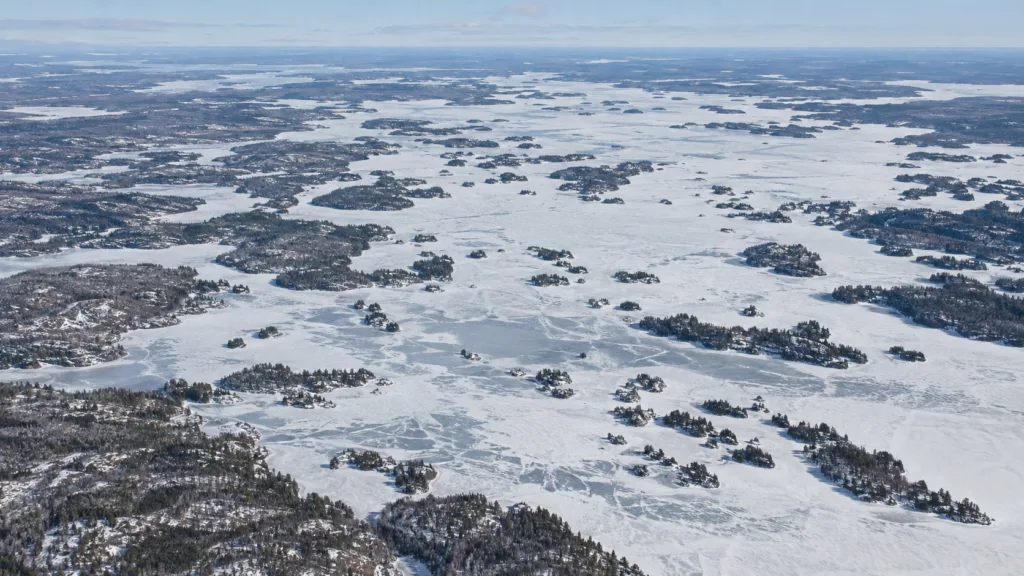
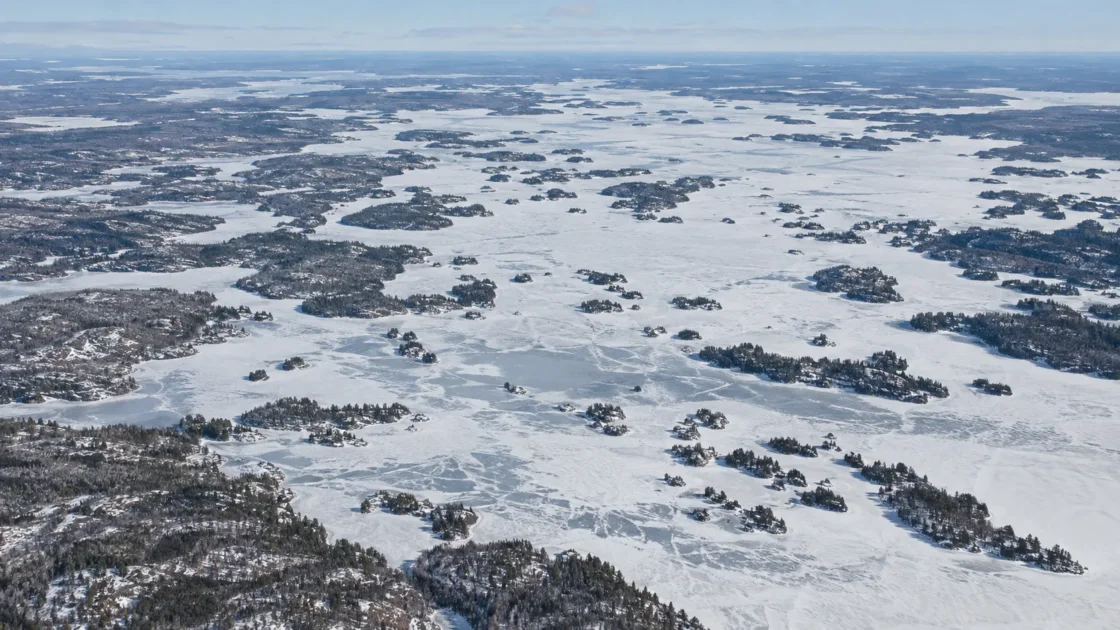
Regular complete seasonal freeze-over
Official Seasonal MonitoringNational Park Service — Seasonal Weather, Voyageurs National ParkNational Park Service — Winter in VoyageursNational Park Service — Spring in VoyageursEvidence: HighWhere Is Rainy Lake?
Ontario / Minnesota · Canada / United States
Rainy Lake on the Globe
Rotate the world or focus directly on the lake.
Measured Ice and Freeze Data
Freeze and Ice Cover Through the Year
Month-level states are shown only when supported. Unclassified months remain explicitly marked.
Evidence Behind the Freeze Profile
Voyageurs National Park defines ice-in as the first time the entire lake is frozen over and the ice cover then remains through winter; its Rainy Lake record reports an average ice-on date of December 9.
Official Seasonal MonitoringNational Park Service — Seasonal Weather, Voyageurs National ParkNational Park Service — Winter in VoyageursEvidence: HighNPS reports a May 3 average, while Minnesota DNR reports a May 4 historical median. The one-day difference reflects different summary statistics rather than incompatible observations.
Official Climate RecordsNational Park Service — Seasonal Weather, Voyageurs National ParkNational Park Service — Spring in VoyageursMinnesota DNR — Lake Ice Out Records for Selected LakesEvidence: HighMinnesota DNR records place the earliest Rainy Lake ice-out at April 6, 2012 and the latest at May 22, 1950.
Official Climate RecordMinnesota DNR — Lake Ice Out Records for Selected LakesEvidence: HighA peer-reviewed analysis reported an average Rainy Lake ice-out of May 3 with year-to-year variation of about 8.6 days. The earliest dates in that analysis occurred after 2000, while its comparison of 1977–1999 with 2000–2011 did not show a clear shift between the two periods.
Peer ReviewedJAWRA — Trophic State in Voyageurs National Park Lakes Before and After Implementation of a Revised Water-Level Management PlanEvidence: ModerateSources
- National Park Service — Seasonal Weather, Voyageurs National Park
- National Park Service — Winter in Voyageurs
- National Park Service — Spring in Voyageurs
- Minnesota DNR — Lake Ice Out Records for Selected Lakes
- JAWRA — Trophic State in Voyageurs National Park Lakes Before and After Implementation of a Revised Water-Level Management Plan
- National Park Service — Rainy Lake
- Natural Resources Canada — Canadian Geographical Names Database: Rainy Lake
Rainy Lake normally develops complete seasonal ice cover rather than remaining as a patchwork of open water and frozen bays through winter. Its winter record is best understood as a cycle with a fairly stable seasonal shape but movable boundaries: freeze-over centers on early December, while breakup can move through a much wider part of spring.
What “ice-in” actually means on Rainy Lake
The National Park Service uses a demanding definition for ice-in at Voyageurs National Park. It is not the first shoreline skim, the freezing of Black Bay, or ice appearing in sheltered coves. Ice-in is recorded when the entire lake has frozen over for the first time and that ice cover remains through winter.
That definition matters on Rainy Lake because it separates early local ice formation from stable lake-wide freeze-over. A large border lake can have protected water freezing while exposed reaches are still affected by wind and stored heat. Only after that remaining open water closes does the NPS ice-in criterion apply.
A large basin has to lose its stored heat before stable ice can take over
Rainy Lake is about 60 miles long and covers roughly 227,604 acres according to the National Park Service. It is therefore very different thermally from a small, sheltered northern lake. Water accumulated during the warm season must cool toward freezing, and wind can continue mixing exposed parts of the lake while that cooling occurs.
The NPS specifically identifies air temperature, water temperature, wind, rain and snow as variables that alter freeze-up and thaw from one year to another. Persistent continental cold eventually favors full winter cover, but the route to that state is not identical every December. A calm, sharply cold period can close remaining open water more quickly than a windy or unusually mild start to winter.
Rainy Lake ice-out is a defined observation, not a claim about every cove at once
The NPS spring record gives an important limitation to the ice-out date. For its Rainy Lake observations, ice-out occurs when the lake is completely free of ice along the route from the Rainy Lake Visitor Center to Kettle Falls Hotel. That creates a repeatable lake-scale indicator, but it should not be read as proof that the final remnant of ice disappeared from every sheltered shoreline at exactly the same moment.
Minnesota DNR records also illustrate why the word “ice-out” needs context. Across Minnesota, observers may use complete disappearance of ice, a consistent navigable route, or another established local criterion. Consistency within a lake’s historical record is more useful for long-term comparison than assuming every lake in the state was judged with an identical visual test.
This also explains why the NPS average of May 3 and the Minnesota DNR median of May 4 can coexist. A mean and a median answer different statistical questions, and the underlying monitoring conventions must be kept attached to the dates.
Spring breakup can move across more than six weeks of the calendar
The historical extremes show far more variability than an early-May average alone suggests. Minnesota DNR records list April 6, 2012 as the earliest Rainy Lake ice-out and May 22, 1950 as the latest. Those endpoints are separated by more than six weeks.
That range is a useful description of Rainy Lake’s spring behavior. Sunlight, air temperature, rain, wind, snow remaining on the ice and the condition of the ice itself all affect how quickly a winter cover deteriorates. An early warm spring can move the process far into April, while persistent cold can retain ice well into May.
Does the ice-out record show a long-term shift?
Rainy Lake has a long enough ice-out history for changes over time to be examined, but the result depends on the period and statistical treatment. A peer-reviewed study of Voyageurs National Park lakes reported an average Rainy Lake ice-out of May 3 with year-to-year variation of about 8.6 days. The earliest dates in that analysis occurred after 2000.
The same study, however, did not detect a clear difference when it divided the record into 1977–1999 and 2000–2011 periods. Earlier work using the longer Rainy Lake record had reported a tendency toward earlier ice-out. These findings are not mutually exclusive: a long record can contain unusually early recent events without every shorter comparison producing a distinct shift. For Rainy Lake, the record supports tracking breakup phenology over decades rather than treating one exceptionally early spring as the new normal.
Similar Lakes by Freeze Pattern
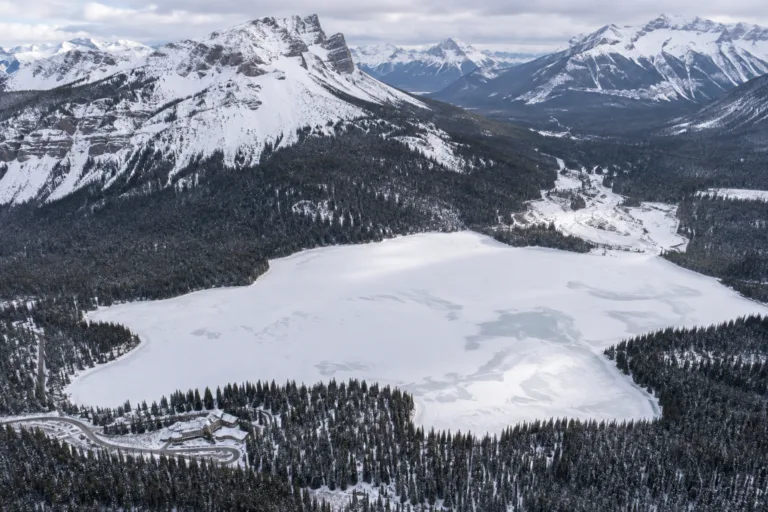
Emerald Lake Freeze
Usually Fully Freezes
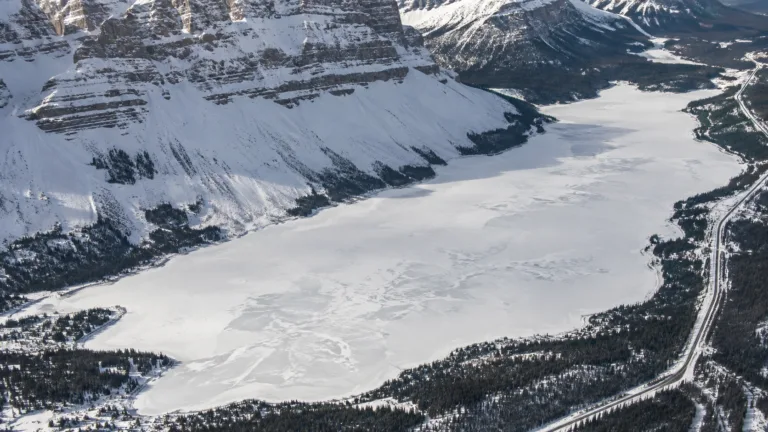
Bow Lake Freeze
Usually Fully Freezes
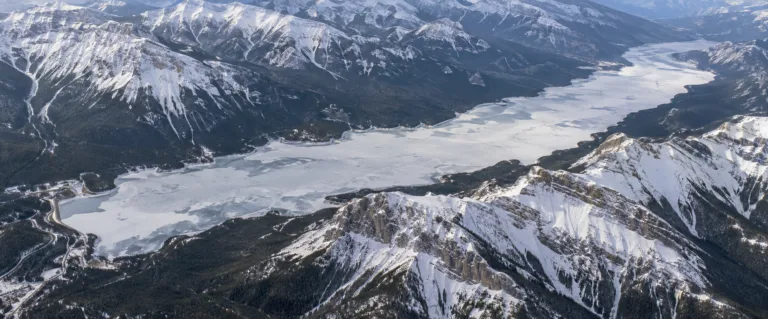
Lake Minnewanka Freeze
Usually Fully Freezes
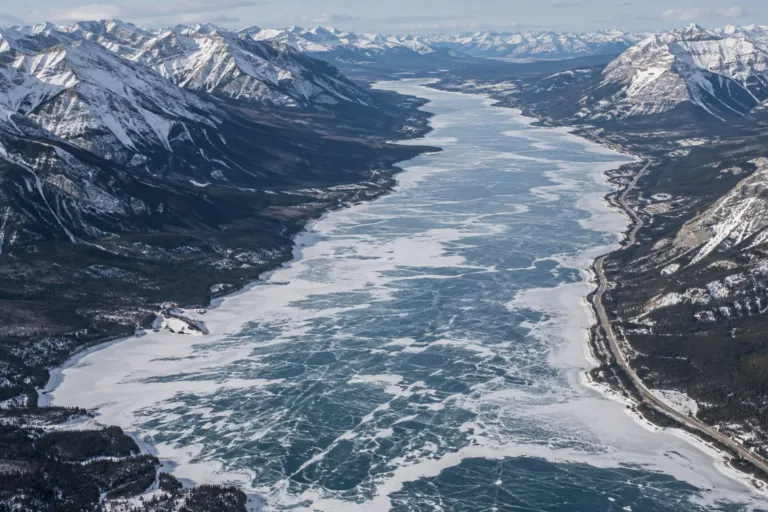
Abraham Lake Freeze
Usually Fully Freezes
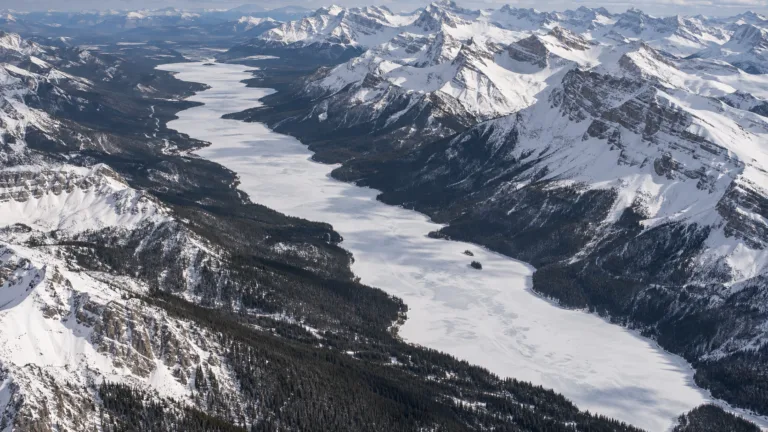
Maligne Lake Freeze
Usually Fully Freezes
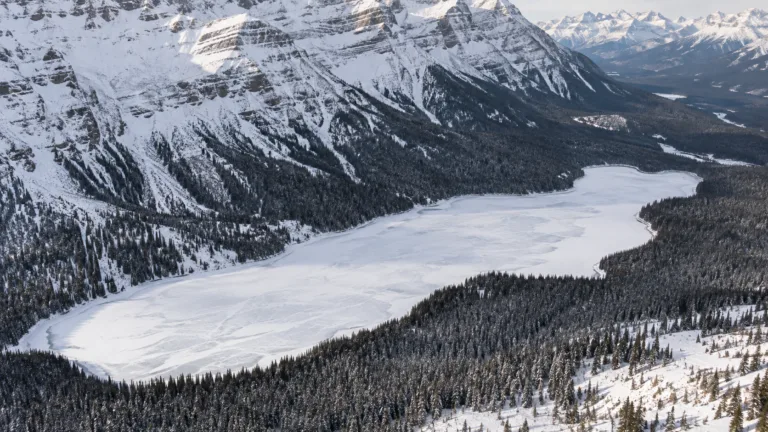
Peyto Lake Freeze
Usually Fully Freezes