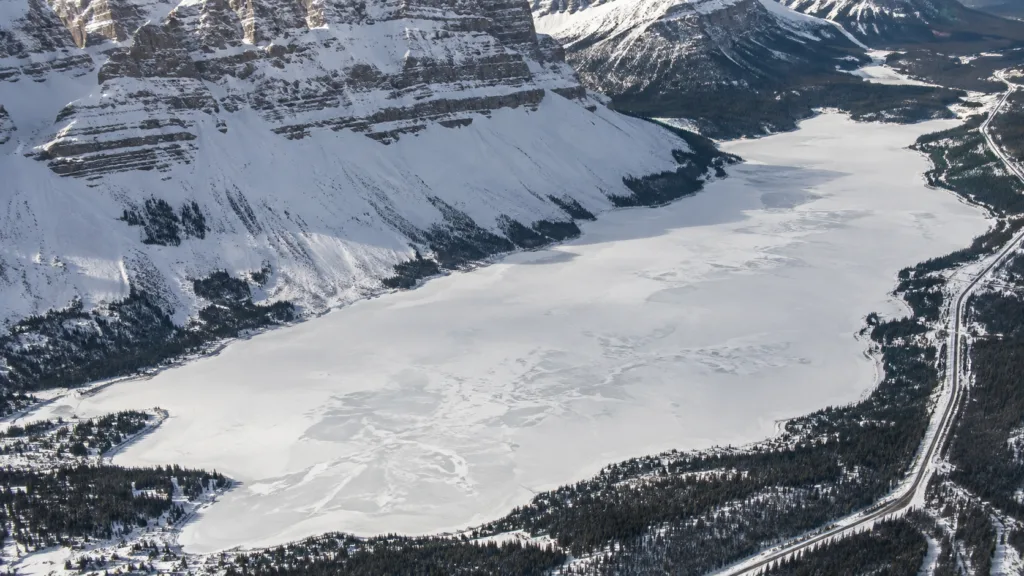
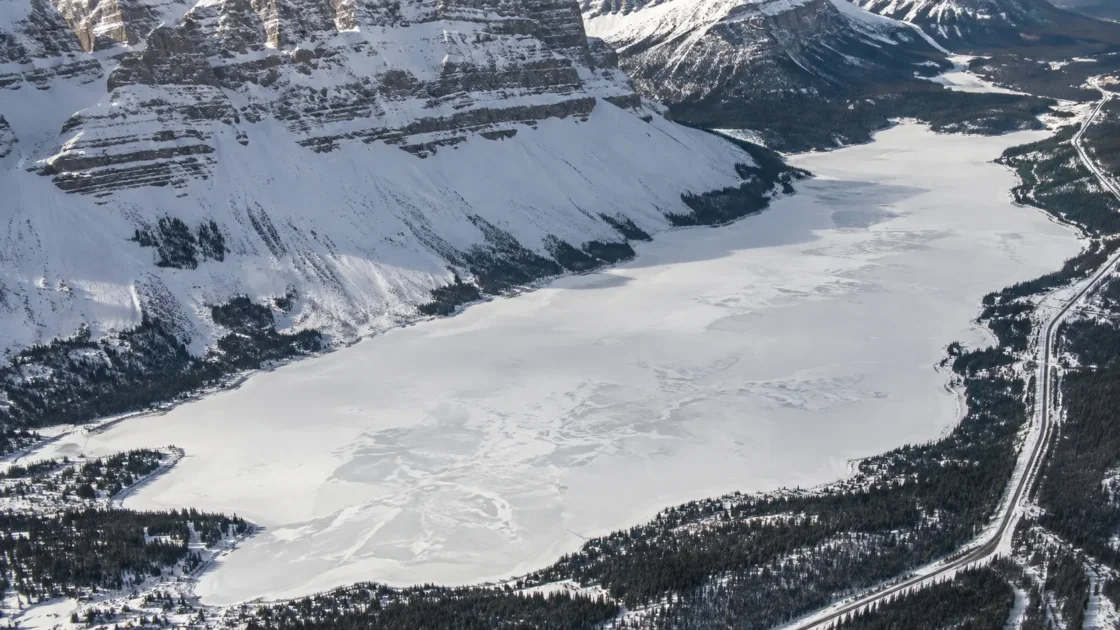
Seasonal complete winter ice cover
Institutional Winter Documentation + Peer Reviewed Catchment ScienceTravel Alberta — Private Lake Louise & Icefields Parkway TourThe Lodge at Bow Lake — Winter at The LodgeLafrenière and Sharp (2003), Hydrological ProcessesThe Cryosphere (2026) — Mountain Snow Modeling in the Bow BasinEvidence: ModerateBow Lake sits at about 1,920 m in a cold Rocky Mountain headwater basin. Prolonged winter cooling allows lake-wide surface ice to form, while glacier- and snowmelt-fed inflows dominate the warm-season hydrology rather than preventing winter freeze-over.
Where Is Bow Lake?
Alberta · Canada
Bow Lake on the Globe
Rotate the world or focus directly on the lake.
Measured Ice and Freeze Data
Evidence Behind the Freeze Profile
Travel Alberta describes Bow Lake as a frozen winter destination, and the lakeside lodge documents winter travel across the frozen lake. These recurring, lake-specific records support a regular freeze-over pattern, though they are not a standardized phenology series.
Institutional Winter DocumentationTravel Alberta — Private Lake Louise & Icefields Parkway TourThe Lodge at Bow Lake — Winter at The LodgeEvidence: ModeratePeer-reviewed Bow Basin research places the headwaters at Bow Lake at about 1,920 m above sea level, exposing the lake to a prolonged cold season in the Canadian Rockies.
Peer ReviewedThe Cryosphere (2026) — Mountain Snow Modeling in the Bow BasinEvidence: HighHydrological research identifies a principal glacial stream draining the Wapta Icefields and a snowmelt-fed Bow River catchment entering Bow Lake.
Peer ReviewedLafrenière and Sharp (2003), Hydrological ProcessesEvidence: HighPublic winter records establish the recurring frozen state, but they do not provide a standardized multi-year Bow Lake ice-on and ice-off series from which a dependable median date can be calculated.
InterpretedTravel Alberta — Private Lake Louise & Icefields Parkway TourThe Lodge at Bow Lake — Winter at The LodgeParks Canada — Travelling the Icefields ParkwayEvidence: LimitedSources
- Canadian Geographical Names Database — Bow Lake
- Travel Alberta — Private Lake Louise & Icefields Parkway Tour
- The Lodge at Bow Lake — Winter at The Lodge
- Lafrenière and Sharp (2003), Hydrological Processes
- Parks Canada — Travelling the Icefields Parkway
- The Cryosphere (2026) — Mountain Snow Modeling in the Bow Basin
- Journal of Geophysical Research: Biogeosciences (2024) — Canadian Rocky Mountain Glacial Headwaters
Bow Lake develops broad, persistent winter ice cover and normally freezes across its surface during the cold season. Its position near the Continental Divide, at roughly 1,920 metres above sea level, gives it a much colder seasonal setting than lower-elevation lakes farther down the Bow River system. The exact dates when continuous ice first forms and finally disappears can move from year to year, so a fixed freeze-up or breakup date would imply more precision than the available Bow Lake record supports.
Why a glacier-fed lake can still freeze completely
Bow Lake is closely tied to glacier melt. Hydrological studies describe a major inflow draining the Wapta Icefields, while another part of the lake’s headwater system is dominated by seasonal snowmelt. That glacier-fed identity is most important during the melt season. It does not mean that moving meltwater keeps the lake open through winter.
Once autumn cooling removes the heat stored in the lake, surface water can reach the freezing point and begin forming ice. The long cold season at this elevation gives that process time to spread across the lake. Snow accumulating on top of the ice then changes the surface energy balance by insulating the ice from the air and reducing the amount of solar energy reaching the water below.
Elevation matters more than the lake’s glacial label
Bow Lake lies at the headwaters of the Bow River in a high Rocky Mountain basin. Peer-reviewed work places this headwater setting at about 1,920 metres above sea level, while modern research describes Bow Lake as a subalpine lake with a surface area of roughly 2.8 square kilometres.
Those physical characteristics help explain its winter behaviour. The lake is large enough to store summer heat, but it is not protected from freezing by the enormous volume and thermal inertia found in some very large, deep lakes. Prolonged cold at high elevation can remove enough heat for seasonal ice to become lake-wide.
The frozen season is clearer than its exact boundary dates
Winter documentation from the Bow Lake area repeatedly shows and describes a frozen lake, including winter use of the lake surface and snow-covered conditions around the shoreline. That supports a recurring complete-freeze pattern rather than isolated shoreline ice.
The transition dates deserve more restraint. Bow Lake does not have a widely published long-term ice phenology series comparable with lakes where observers have recorded one standardized ice-on and ice-off date every year for decades. Freeze-up can therefore shift with autumn temperatures, wind, snowfall and the amount of heat retained in the water. Spring breakup likewise responds to air temperature, solar radiation, snow cover, wind and meltwater entering the basin.
For the same reason, one photograph of an icy spring or an unusually early open-water season should not be treated as Bow Lake’s permanent norm. Individual years can move through breakup at noticeably different rates.
Winter ice and summer inflow belong to the same annual cycle
The lake’s hydrology changes sharply with the seasons. Research on the Bow Lake catchment shows strong warm-season contributions from glacier melt and snowmelt. As spring advances, increasing runoff enters the lake while its snow and ice cover absorbs more energy and begins to deteriorate. During summer, glacier-derived and snowmelt-derived water become much more prominent in the lake’s water balance.
That seasonal reversal is central to Bow Lake’s freeze pattern: a frozen high-elevation lake in winter becomes an active meltwater-fed headwater lake during the warmer part of the year. The two conditions are not contradictory. They are different phases of the same alpine hydrological cycle.
No verified long-term freeze trend for Bow Lake
Changes in mountain snow, glacier mass and regional climate are well documented across the Canadian Rockies, but those broader changes should not automatically be converted into a Bow Lake-specific trend in freeze-up or breakup dates. A dependable statement that Bow Lake now freezes later, thaws earlier or has lost a certain number of ice-covered days would require a consistent multi-decadal lake-ice record using comparable definitions.
Without that record, the strongest description remains more limited: Bow Lake is a regularly freezing, glacier-fed mountain lake with complete seasonal winter ice, while the exact timing of formation and breakup varies between years.
Similar Lakes by Freeze Pattern
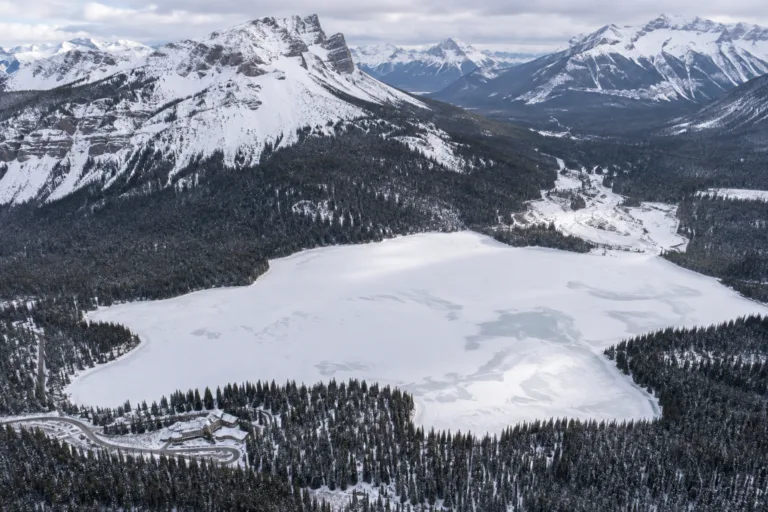
Emerald Lake Freeze
Usually Fully Freezes
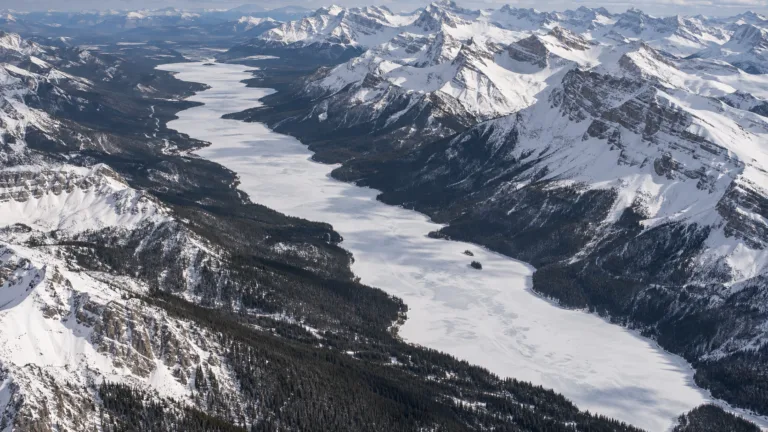
Maligne Lake Freeze
Usually Fully Freezes
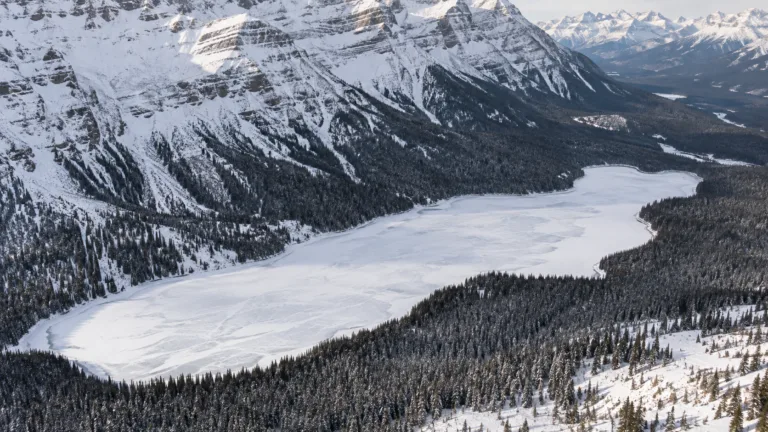
Peyto Lake Freeze
Usually Fully Freezes

Moraine Lake Freeze
Usually Fully Freezes
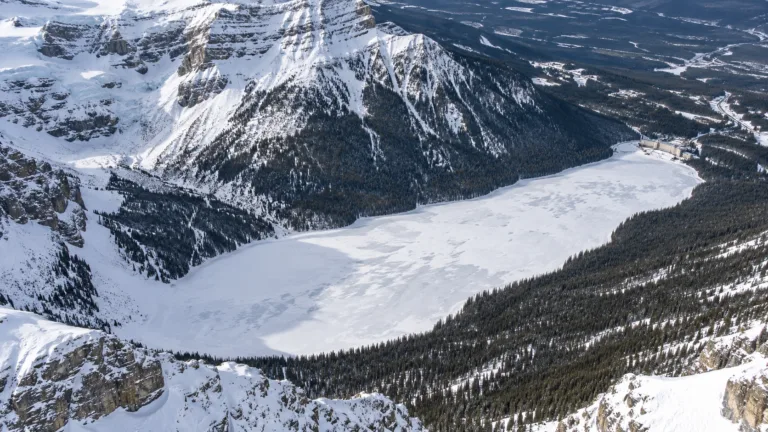
Lake Louise Freeze
Usually Fully Freezes
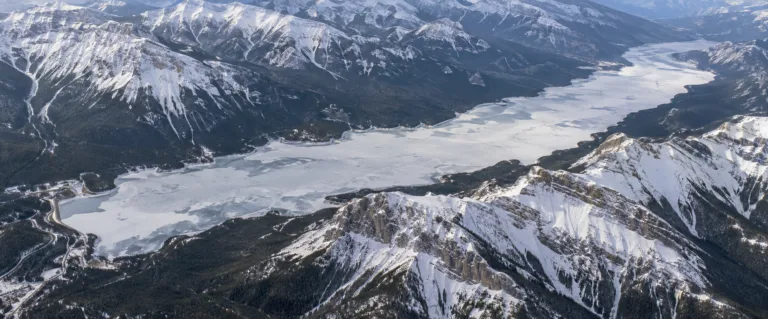
Lake Minnewanka Freeze
Usually Fully Freezes