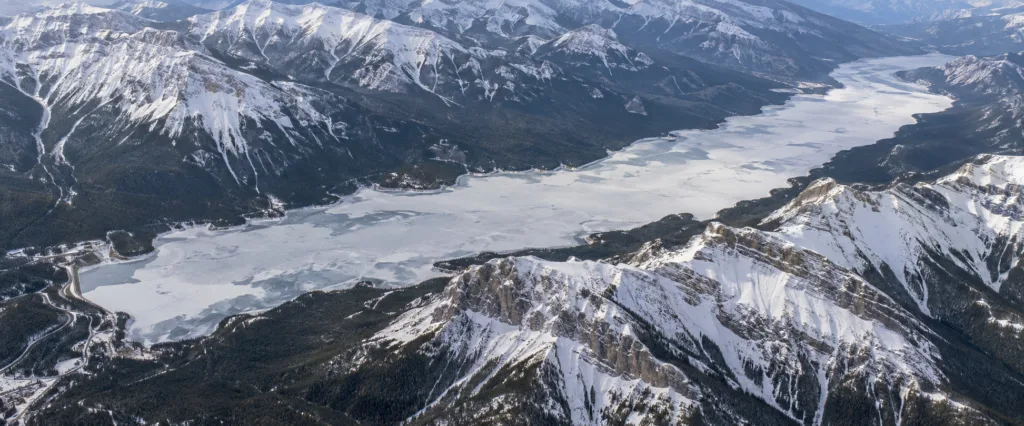
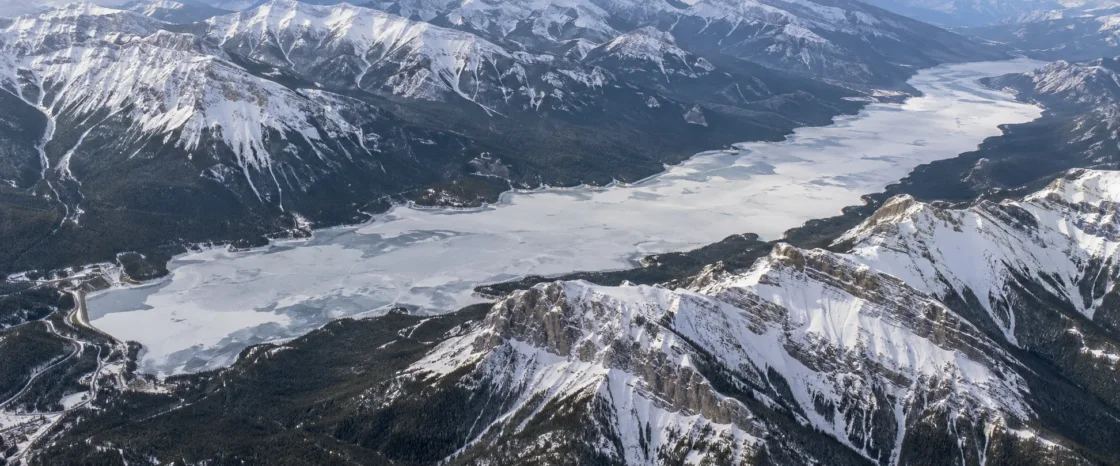
Seasonal full freeze-over, reached relatively late in winter
Historical Monitoring Record and Peer ReviewedEnvironment Canada — Freeze-up and Break-up Dates of Water Bodies in Canada (1971)Parks Canada — Scuba Diving: Lake MinnewankaGlobal News — Parks Canada Thin-Ice Warning for Lake MinnewankaBonsal et al. (2006) — Impacts of Large-Scale Teleconnections on Freshwater-Ice Break/Freeze-Up Dates over CanadaEvidence: ModerateThe reservoir is about 18 km long and reaches 100 m depth. Its large, deep water body stores heat and remains exposed to wind-driven mixing, delaying complete closure; changing reservoir levels add shoreline variability.
Where Is Lake Minnewanka?
Alberta · Canada
Lake Minnewanka on the Globe
Rotate the world or focus directly on the lake.
Measured Ice and Freeze Data
Freeze and Ice Cover Through the Year
Month-level states are shown only when supported. Unclassified months remain explicitly marked.
Evidence Behind the Freeze Profile
The federal ice record summarized observations beginning in 1940 with an earliest freeze-up of Nov 26, a mean of Dec 24 and a latest of Jan 25.
Historical Monitoring RecordEnvironment Canada — Freeze-up and Break-up Dates of Water Bodies in Canada (1971)Evidence: HighThe same record lists water free of ice from Apr 29 at the earliest to Jun 7 at the latest, with a mean date of May 17.
Historical Monitoring RecordEnvironment Canada — Freeze-up and Break-up Dates of Water Bodies in Canada (1971)Evidence: HighParks Canada has attributed Minnewanka's late freeze-over to its size and depth and identified the west end near Lake Minnewanka Road as the last part to freeze.
Official Statement Reported by Established News SourceGlobal News — Parks Canada Thin-Ice Warning for Lake MinnewankaEvidence: ModerateParks Canada records seasonal depth changes of up to 5.5 m and notes that reservoir-level variation can produce shoreline cracking during winter.
Government Lake Data and Official StatementParks Canada — Scuba Diving: Lake MinnewankaGlobal News — Parks Canada Thin-Ice Warning for Lake MinnewankaEvidence: HighA 1950–1999 peer-reviewed analysis reported an autumn North Pacific index correlation of r = -0.41 with Lake Minnewanka freeze-up timing and found no clear long-term freeze-up trend for the region.
Peer ReviewedBonsal et al. (2006) — Impacts of Large-Scale Teleconnections on Freshwater-Ice Break/Freeze-Up Dates over CanadaEvidence: HighSources
- Canadian Geographical Names Database — Lake Minnewanka
- Environment Canada — Freeze-up and Break-up Dates of Water Bodies in Canada (1971)
- Parks Canada — Scuba Diving: Lake Minnewanka
- Global News — Parks Canada Thin-Ice Warning for Lake Minnewanka
- Bonsal et al. (2006) — Impacts of Large-Scale Teleconnections on Freshwater-Ice Break/Freeze-Up Dates over Canada
Lake Minnewanka normally develops complete seasonal ice cover, but it closes later than many smaller waters in the Banff area. Its freeze-up date has varied by many weeks in the historical record, and the reservoir does not freeze uniformly from one end to the other.
Why a cold mountain lake can still freeze late
Elevation alone does not determine when a lake seals over. Lake Minnewanka sits about 1,450 m above sea level, yet Parks Canada describes it as roughly 18 km long and up to 100 m deep. That volume allows the lake to retain summer and autumn heat well after air temperatures have fallen below freezing.
Wind matters as well. Repeated mixing can bring relatively warmer water back toward the surface and interrupt early ice formation. This helps explain why smaller nearby lakes may develop continuous ice before Minnewanka, even though they share the same regional winter weather.
The west end can lag behind the rest of the reservoir
Parks Canada has identified the west end near Lake Minnewanka Road as the last part of the lake to freeze. That detail matters because a local sheet of shore ice does not describe the condition of the whole reservoir. Freeze-over progresses across a long, wind-exposed basin, so one sector can remain open after ice has already formed elsewhere.
This spatial pattern also separates “first ice” from “full freeze-over.” A winter photograph showing ice at one access point may document local closure without establishing that the entire lake surface had frozen on that date.
Historical records show a wide timing range
Federal observations summarized from a record beginning in 1940 place freeze-up as early as November 26 and as late as January 25, with a mean date of December 24. Spring clearance was also variable: the earliest recorded water-free-of-ice date was April 29, the mean was May 17 and the latest was June 7.
Those values are useful as a historical baseline, not as fixed modern normals. They show that Minnewanka’s ice season can shift by several weeks from year to year. They also describe seasonal event dates rather than ice thickness or percentage cover, so they should not be read as measurements of how uniform the ice was across the lake.
Reservoir operation changes the shoreline environment
Lake Minnewanka is a regulated reservoir rather than a lake with a nearly fixed winter water level. Parks Canada reports that depth at its dive sites can vary by as much as 5.5 m from spring to fall, and winter guidance has noted that changing water levels can crack ice near the shoreline.
The effect is local as well as seasonal. When the water surface moves beneath an existing ice cover, the ice edge can separate from the shore or deform even while broader parts of the reservoir remain frozen. That makes shoreline appearance a poor substitute for a lake-wide freeze record.
Freeze-up also tracks large-scale Pacific weather patterns
A peer-reviewed study of Canadian freshwater ice compared Lake Minnewanka freeze-up dates with large-scale atmospheric patterns over 1950–1999. The Minnewanka series showed an autumn North Pacific index correlation of r = -0.41, linking part of the year-to-year timing variability to changes in Pacific-sector circulation.
The same analysis did not identify a clear long-term freeze-up trend for the region over that study period. That distinction is important: strong year-to-year shifts can exist even when a persistent directional trend is difficult to detect in the available freeze-up record.
Similar Lakes by Freeze Pattern
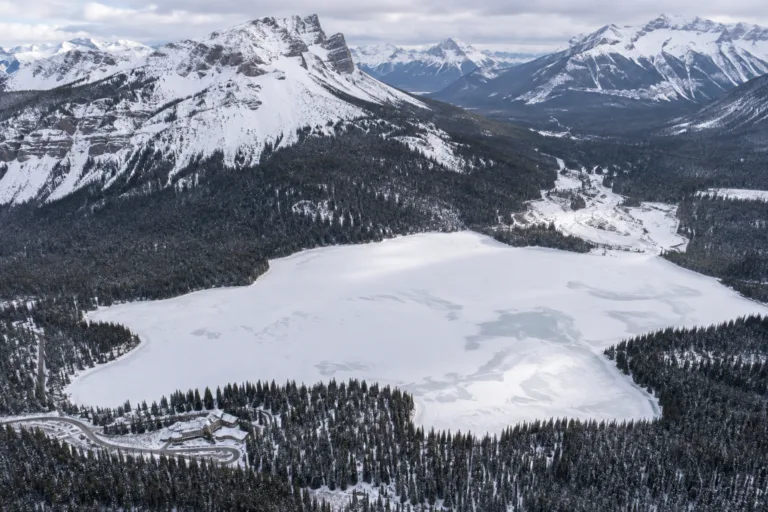
Emerald Lake Freeze
Usually Fully Freezes
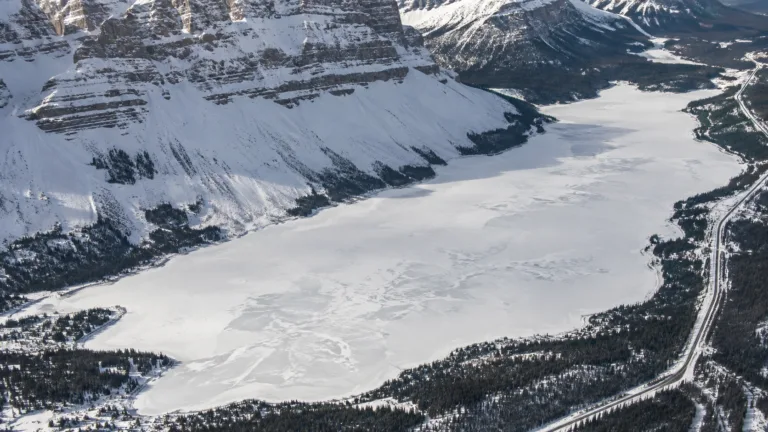
Bow Lake Freeze
Usually Fully Freezes
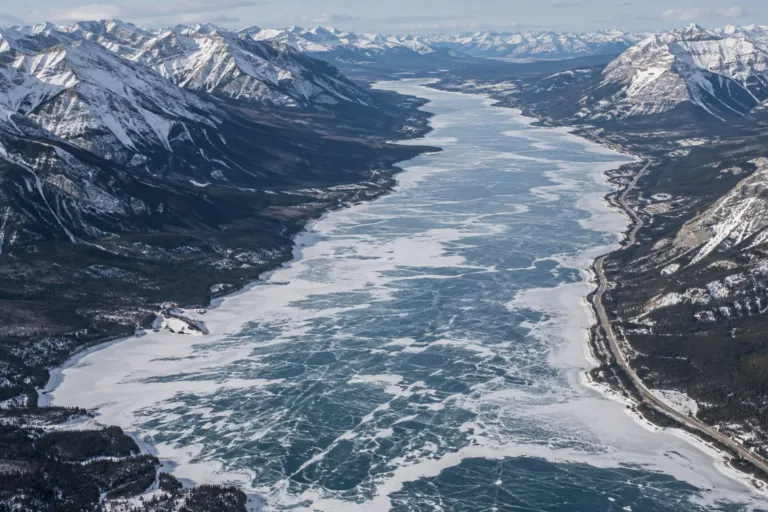
Abraham Lake Freeze
Usually Fully Freezes
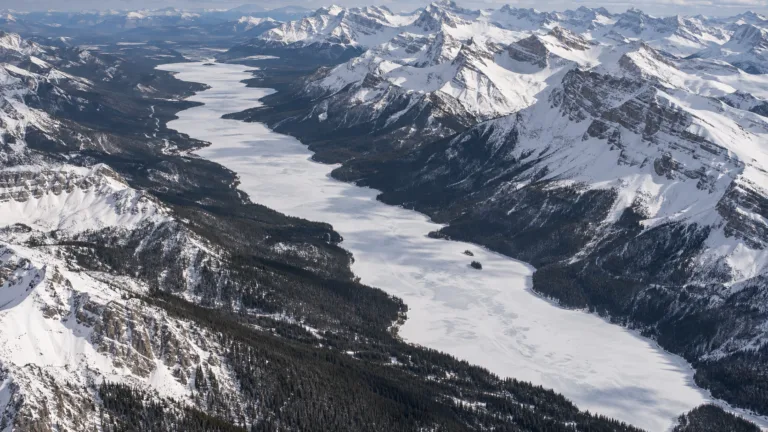
Maligne Lake Freeze
Usually Fully Freezes
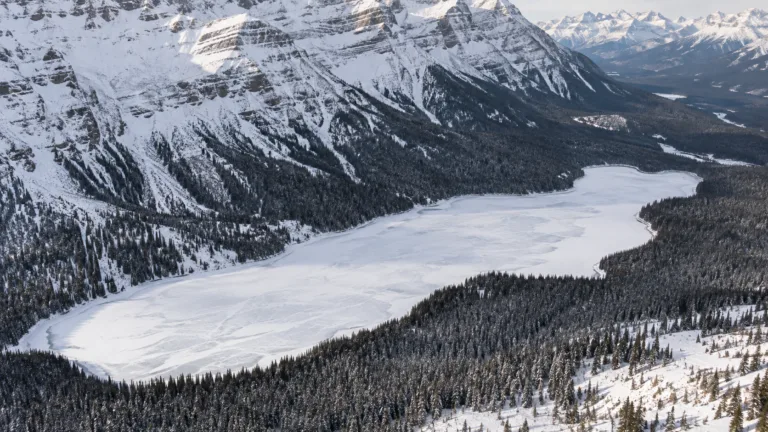
Peyto Lake Freeze
Usually Fully Freezes

Moraine Lake Freeze
Usually Fully Freezes