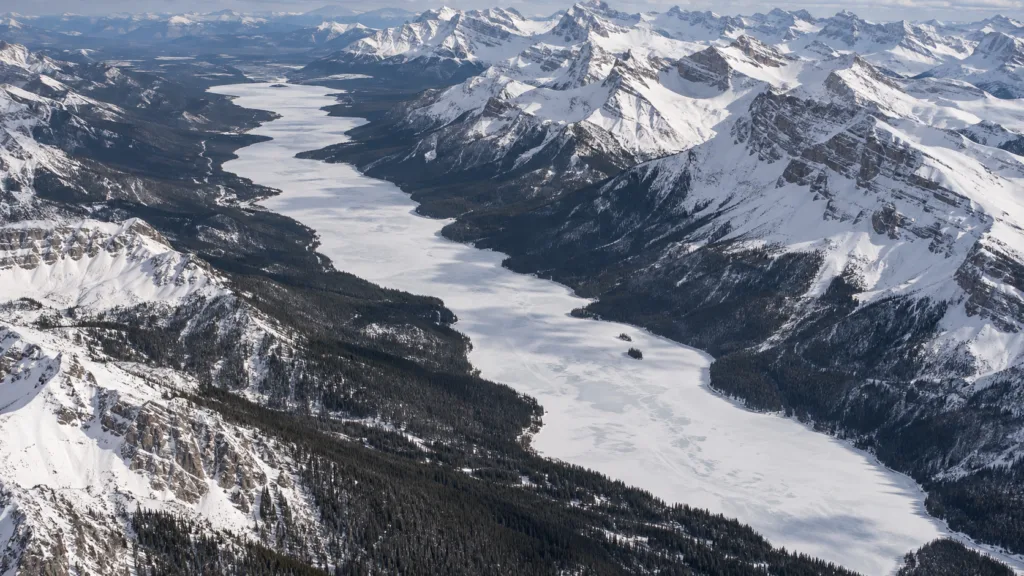
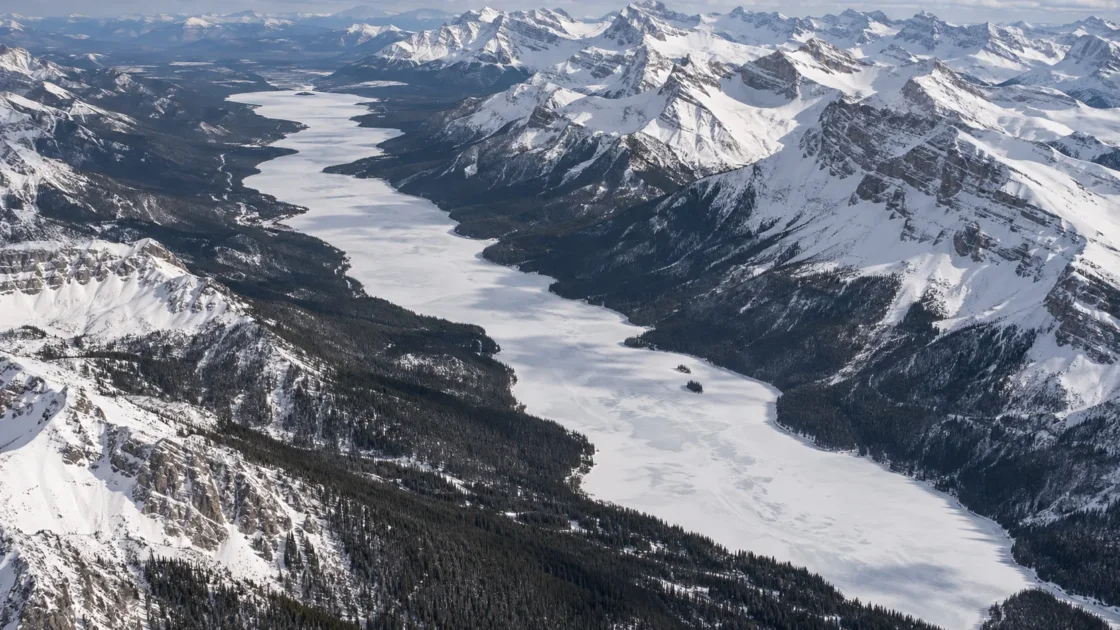
Seasonal lake-wide ice cover through the core of winter
Government winter guidance and research observationsParks Canada — Maligne Valley in WinterParks Canada — Maligne LakeNatural Resources Canada — Advanced SAR Applications for Canada's CryosphereLibrary and Archives Canada — McCutchen, Temporal and Spatial Patterns of Stonefly Nymph Abundance in the Maligne RiverAgriculture Canada — Jasper National Park Biophysical Land Classification, Volume IIEvidence: ModerateCold alpine winters favor complete ice cover, while the lake's deep basin and exposure to high winds can make the transitions into and out of stable ice less abrupt than air temperature alone would suggest.
Where Is Maligne Lake?
Alberta · Canada
Maligne Lake on the Globe
Rotate the world or focus directly on the lake.
Measured Ice and Freeze Data
Freeze and Ice Cover Through the Year
Month-level states are shown only when supported. Unclassified months remain explicitly marked.
Evidence Behind the Freeze Profile
Parks Canada describes Maligne Lake as frozen and snow-covered in winter and identifies winter routes along the lake.
Official Winter GuidanceParks Canada — Maligne Valley in WinterEvidence: HighMaligne Lake boat surveys in the watershed study were conducted after ice-off, described in the study as usually occurring in early June.
Scientific Field RecordLibrary and Archives Canada — McCutchen, Temporal and Spatial Patterns of Stonefly Nymph Abundance in the Maligne RiverEvidence: ModerateNatural Resources Canada's 2011 RADARSAT-2 sequence covered late October to mid-December during a season affected by intermittent warmth, rain, snow and flooded snow.
Government Remote Sensing StudyNatural Resources Canada — Advanced SAR Applications for Canada's CryosphereEvidence: HighThe Natural Resources Canada report states that many more years of lake-ice observations would be required before trends could be identified.
Government Remote Sensing StudyNatural Resources Canada — Advanced SAR Applications for Canada's CryosphereEvidence: HighSources
- Parks Canada — Maligne Valley in Winter
- Parks Canada — Maligne Lake
- Natural Resources Canada — Canadian Geographical Names Database: Maligne Lake
- Natural Resources Canada — Advanced SAR Applications for Canada's Cryosphere
- Library and Archives Canada — McCutchen, Temporal and Spatial Patterns of Stonefly Nymph Abundance in the Maligne River
- Agriculture Canada — Jasper National Park Biophysical Land Classification, Volume II
Maligne Lake freezes seasonally and carries broad winter ice cover for much of the cold season. Spring is the less predictable part of the cycle: field work in the Maligne watershed described ice-off as usually occurring in early June, which means substantial ice can remain through May even when lower-elevation lakes have already opened.
Why Maligne Lake holds ice so late into spring
Maligne Lake sits at roughly 1,675 metres above sea level in Jasper National Park. Government survey data place its maximum depth near 96 metres, while Parks Canada describes it as a glacier-fed lake whose water remains exceptionally cold even during summer.
Those characteristics affect different parts of the freeze cycle in different ways. High elevation exposes the basin to a long cold season that supports widespread winter ice. Depth, however, gives the lake a large store of water that must lose heat before stable surface ice can become established. Parks Canada also notes that high winds are common on Maligne Lake. Wind-driven mixing and wave action can delay smooth surface closure during the early part of winter, even while shallow margins are already cooling rapidly.
Once winter cover is established, the high-elevation setting helps it persist far into spring. The result is a much later breakup than on many lakes nearer the Jasper valley floor.
Freeze-up is a process rather than one clean date
A Natural Resources Canada remote-sensing project provides an unusually detailed look at Maligne Lake during the 2011 freeze-up season. RADARSAT-2 imagery followed the lake from October 28 through December 18. That winter did not progress through a simple open-water-to-solid-ice sequence: intermittent warm weather, rainfall and snowfall after freeze-up produced rain-wetted snow and flooded-snow conditions on the ice.
This matters when interpreting a phrase such as “the lake froze.” First ice, widespread surface ice and a stable winter cover are not necessarily the same event. Satellite classification can also encounter surfaces that are neither straightforward open water nor dry snow-covered ice. Maligne Lake’s 2011 record is a good example of why a single freeze date can hide several weeks of changing surface conditions.
Early June is the strongest field-based ice-off reference
A field study conducted in the Maligne watershed from 1997 through 2000 included boat surveys of Maligne Lake after ice-off. The study described ice-off as usually occurring in early June. That observation gives useful seasonal context: May belongs to the late-ice and breakup period rather than reliably open water.
Early June should not be read as a fixed annual deadline. Ice decay responds to the weather of a particular spring, including temperature, wind, incoming solar energy, rain and snow conditions. The field record is therefore more useful as a seasonal anchor than as a prediction for a specific year.
What the 2011 satellite record can tell us
The RADARSAT-2 work was designed to test methods for distinguishing lake ice from open water and complicated snow conditions. Maligne Lake served as a demanding freeze-up case because the surface changed repeatedly during the observation period.
It does not provide a long-term average freeze-on date. The Natural Resources Canada report explicitly noted that many more years of observations would be needed before lake-ice trends could be identified. For Maligne Lake, the defensible picture is therefore seasonal: recurring winter ice, a variable autumn transition, and a spring breakup that can extend to around the beginning of June. A multi-decadal Maligne-specific phenology series would be needed to quantify whether freeze-up is becoming later or ice-off earlier over time.
Similar Lakes by Freeze Pattern
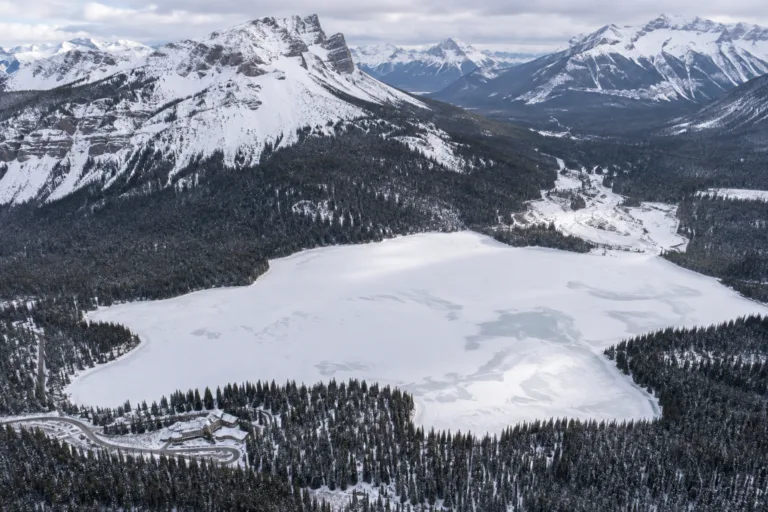
Emerald Lake Freeze
Usually Fully Freezes
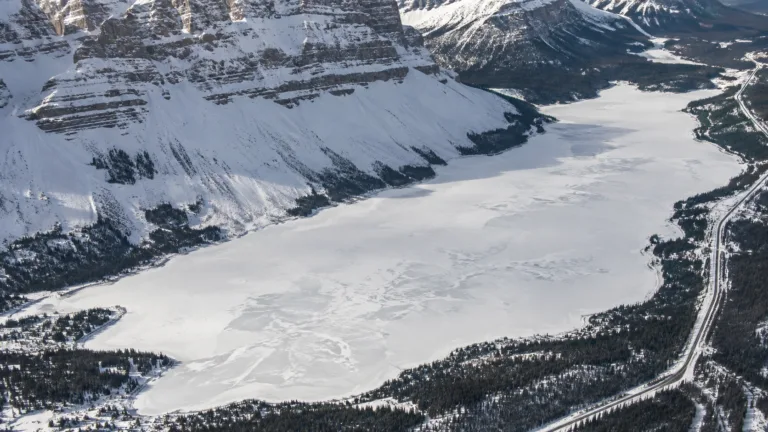
Bow Lake Freeze
Usually Fully Freezes
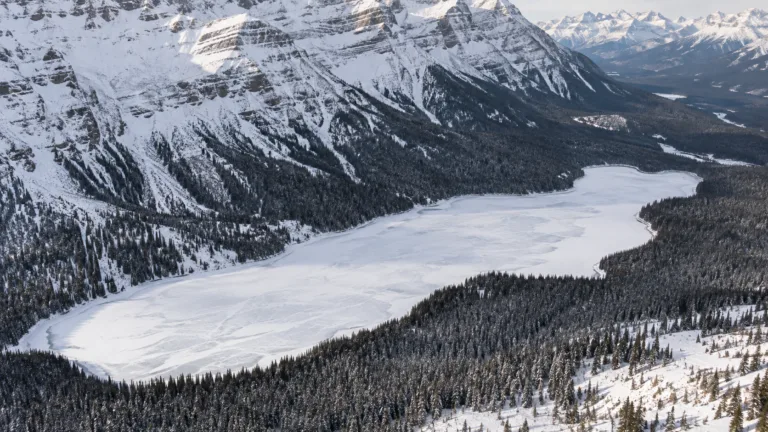
Peyto Lake Freeze
Usually Fully Freezes

Moraine Lake Freeze
Usually Fully Freezes
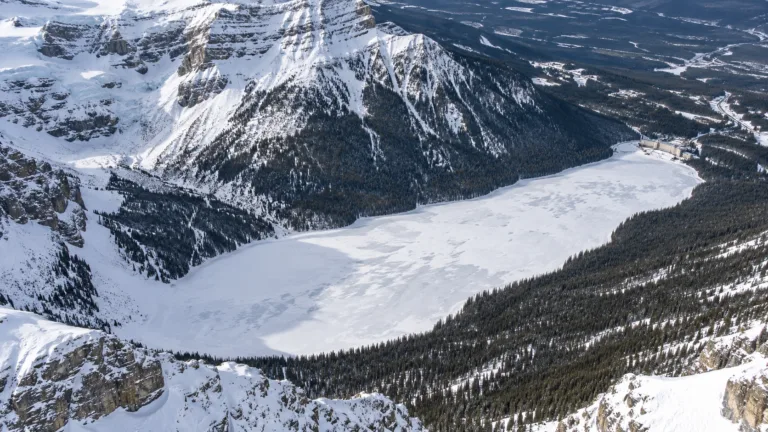
Lake Louise Freeze
Usually Fully Freezes
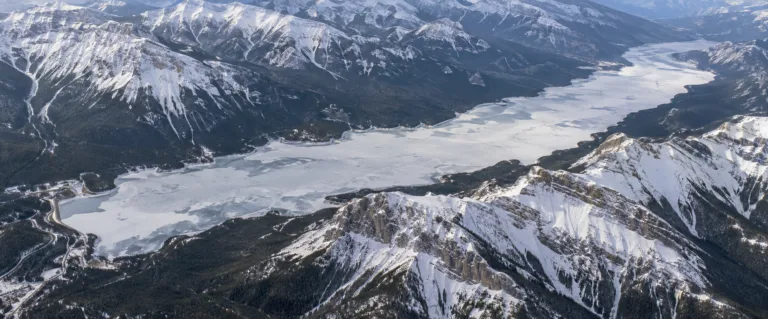
Lake Minnewanka Freeze
Usually Fully Freezes