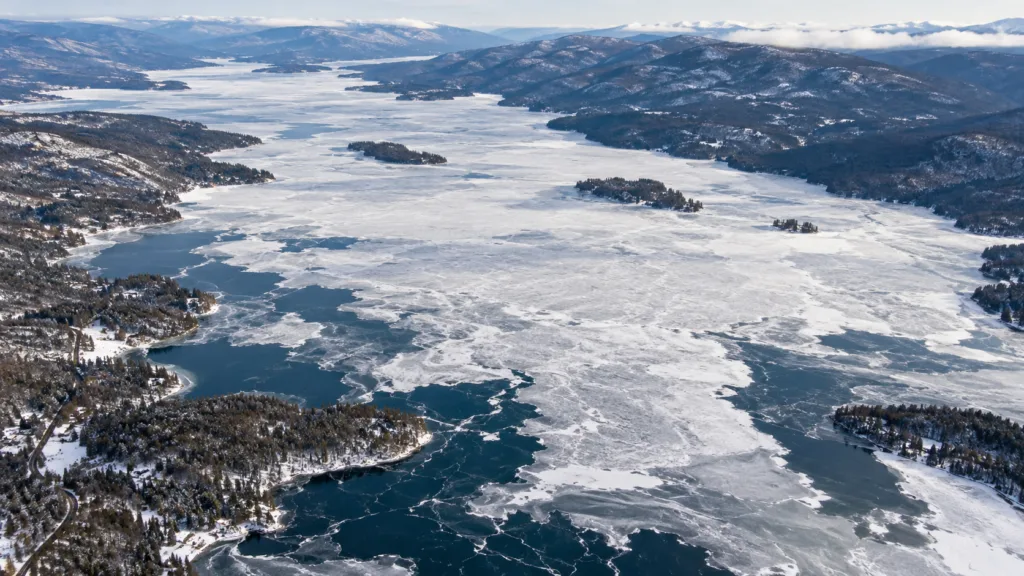
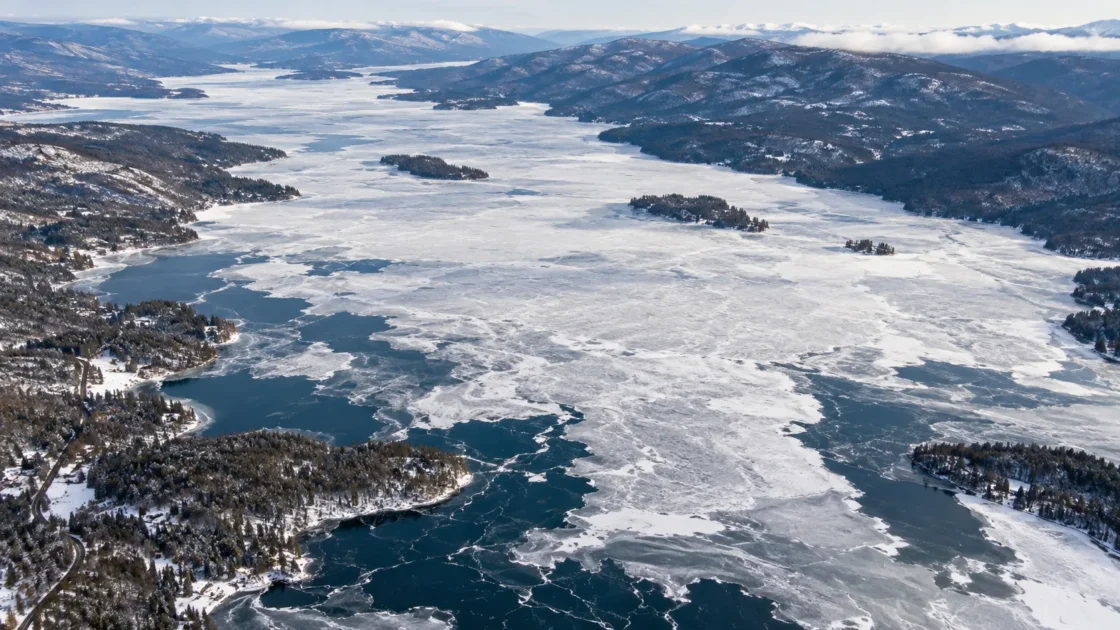
Seasonal ice is common; complete freeze-over is now intermittent.
Peer Reviewed + Historical Monitoring RecordLake George Association — An Historical Look at Ice on Lake GeorgeInternational Journal of Climatology — Predicting Complete Winter Ice Coverage at Lake George, New YorkLake George Association — Lake George Officially Frozen Over, February 4, 2026Evidence: HighIce usually forms first along the edges and spreads inward. In incomplete-freeze winters, the deepest parts of the lake can remain open, so sustained cold is needed for end-to-end ice cover.
Where Is Lake George?
New York · United States
Lake George on the Globe
Rotate the world or focus directly on the lake.
Measured Ice and Freeze Data
Freeze and Ice Cover Through the Year
Month-level states are shown only when supported. Unclassified months remain explicitly marked.
Evidence Behind the Freeze Profile
The peer-reviewed record defines complete coverage as being able to traverse the lake's length without crossing open water; in incomplete years, the deepest water can remain ice-free.
Peer ReviewedInternational Journal of Climatology — Predicting Complete Winter Ice Coverage at Lake George, New YorkEvidence: HighThe study reports that, apart from 1919, complete freeze occurred each winter until 1990; 13 of the 15 incomplete-cover winters in its record occurred from 1990 through 2020.
Peer ReviewedInternational Journal of Climatology — Predicting Complete Winter Ice Coverage at Lake George, New YorkEvidence: HighThe Lake George Association declared end-to-end complete ice cover on February 4, 2026 and reported the official ice-out date as April 2, 2026.
Official Seasonal Lake RecordLake George Association — Lake George Officially Frozen Over, February 4, 2026Lake George Association — 2026 Official Ice-Out DateEvidence: HighNew York State DEC reports a maximum depth of about 57 m (187 ft), while the ice study notes that areas deeper than 50 m can remain open in incomplete-freeze winters.
Government Lake Data + Peer ReviewedNew York State DEC — Lake George Harmful Algal Bloom Action PlanInternational Journal of Climatology — Predicting Complete Winter Ice Coverage at Lake George, New YorkEvidence: HighSources
- Lake George Association — An Historical Look at Ice on Lake George
- International Journal of Climatology — Predicting Complete Winter Ice Coverage at Lake George, New York
- Lake George Association — Lake George Officially Frozen Over, February 4, 2026
- Lake George Association — 2026 Official Ice-Out Date
- USGS Water Data — Lake George at the Narrows, New York
- New York State DEC — Lake George Harmful Algal Bloom Action Plan
Lake George develops substantial winter ice and can freeze completely from its southern end to its northern end, but a full freeze is no longer dependable every winter. Its long ice record is especially useful because “ice-in” refers to complete lake coverage rather than the first appearance of shoreline or bay ice.
Why shoreline ice can appear long before Lake George is officially frozen
Lake George does not freeze as a single surface at once. Ice generally develops along the margins and in shallower water before spreading toward the open lake. That distinction matters on a lake with a deep central basin: the peer-reviewed ice record notes that water deeper than 50 meters can remain open during winters when complete coverage never develops.
This is why visible ice in bays or along the shoreline cannot be treated as an official whole-lake freeze date. The historical Lake George record uses a much stricter threshold for complete ice cover, effectively requiring an unbroken frozen surface along the length of the lake. A winter can therefore produce extensive local ice without receiving an official ice-in date.
The important change in the record occurs around 1990
For much of the twentieth century, complete freeze-over was remarkably consistent. The scientific record reports that Lake George froze completely every winter from the beginning of that record through 1989 except for 1919. The pattern changed sharply around 1990. By the 2020 endpoint of the published analysis, 15 winters in the record had failed to reach complete coverage, and 13 of those incomplete-freeze winters had occurred since 1990.
The change is not simply a matter of slightly different freeze dates. It represents a shift in freeze regime: complete ice still forms in sufficiently cold winters, but winters without end-to-end coverage have become a recurring part of the record. Among seasons that did achieve full cover, the post-1990 average complete-ice period was six days shorter than the 1912–1990 average.
Recent winters show why a variable classification is more accurate than either “usually frozen” or “usually open.” Lake George achieved complete coverage in both 2025 and 2026, with the Lake George Association declaring full cover on February 4, 2026. Official ice-out followed on April 2. Back-to-back complete freezes demonstrate that whole-lake ice remains possible even though the longer record no longer supports treating it as an annual event.
Lake depth makes sustained cold more important than the first cold spell
Lake George is approximately 32 miles long and reaches about 57 meters, or 187 feet, at its deepest point. Its deeper water retains heat longer than shallow shoreline zones, so early winter cooling can create substantial peripheral ice while the deeper open-water sections continue releasing stored heat.
A short cold spell is therefore not enough to explain whether Lake George will ultimately freeze from end to end. The sequence and persistence of winter weather matter. The published Lake George study found that complete coverage cannot be explained by a simple temperature threshold alone; individual winters reflect interacting weather conditions and the lake’s own thermal response. The deepest areas are especially important because they are commonly the last portions to close and can remain open through an incomplete-freeze winter.
Ice-in and ice-out averages describe complete cover, not all winter ice
In the peer-reviewed 1912–2020 record, the mean complete ice-in date was around January 20 and the mean ice-out date around April 12. For the period since 1990, complete-freeze years shifted toward a later mean ice-in date of about January 24 while mean ice-out was around April 10. These dates describe the beginning and end of the defined complete-cover interval; they do not indicate when the first bay freezes or when the final isolated patch of ice disappears.
The historical extremes show how wide the range can be. The Lake George Association records only 13 days of complete cover in 2017, compared with 121 days during the 1983–84 winter. December complete freezes have been unusual in the century-scale record, while January has historically been the dominant month for reaching full coverage.
Why there is no single “typical ice duration” value in this profile
Published summaries of the Lake George record do not give exactly the same average duration. The Lake George Association’s historical summary reports about 76 days of complete ice in winters when the lake freezes, while the peer-reviewed analysis reports an 84-day average for its historical dataset. The sources also describe somewhat different starting points and reporting contexts for the long record.
Because the available summaries do not provide enough methodological detail to reconcile that difference cleanly, a single typical-duration figure would imply more precision than the evidence supports. The profile therefore keeps the directly documented historical extremes and period-specific trend statistics while leaving the typical-duration field unset.
What “full freeze” means when interpreting Lake George records
The century-scale record is categorical rather than a continuous measurement of the percentage of lake surface covered by ice each day. Historical ice-in and ice-out determinations were observational, and the scientific analysis notes that this method carries some subjectivity. It is nevertheless valuable because the definition has focused on complete lake coverage rather than treating scattered winter ice as equivalent to freeze-over.
That distinction also explains why an incomplete-freeze winter should not be read as an ice-free winter. Bays, shoreline zones and shallower sectors may freeze even when deeper open water prevents the lake from qualifying as completely frozen. For Lake George, the most meaningful long-term signal is therefore the increasing occurrence of winters that never cross the complete-cover threshold.
Similar Lakes by Freeze Pattern

Lake Teletskoye Freeze
Variable Full/Partial Freeze
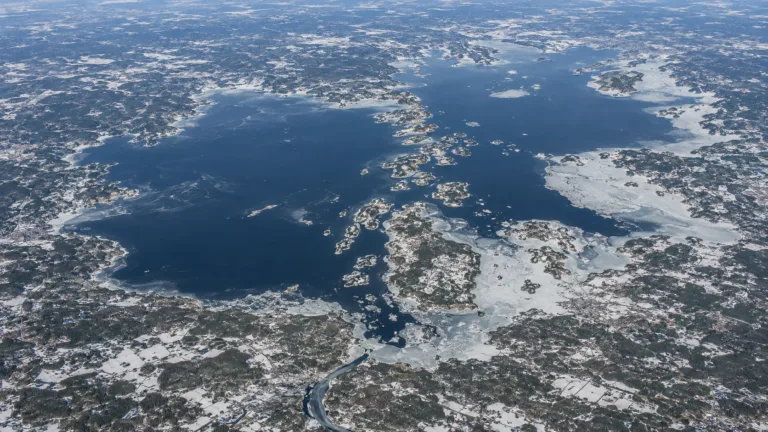
Lake Vänern Freeze
Usually Partially Freezes
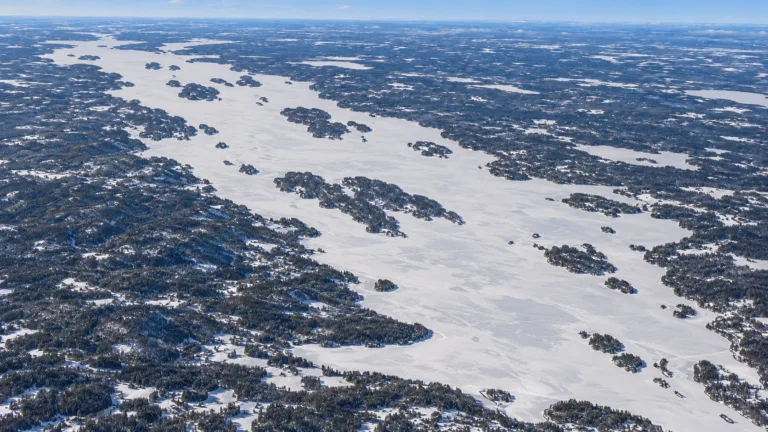
Lake Pielinen Freeze
Usually Fully Freezes
Lake Oulujärvi Freeze
Usually Fully Freezes
Lake Inari Freeze
Usually Fully Freezes
Lake Chany Freeze
Usually Fully Freezes