
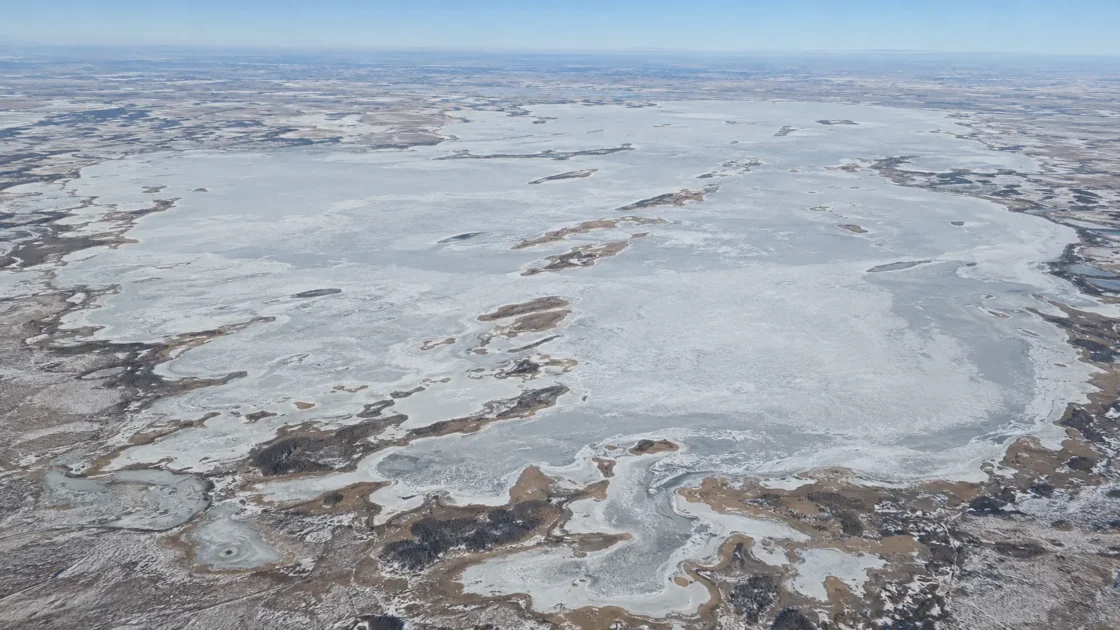
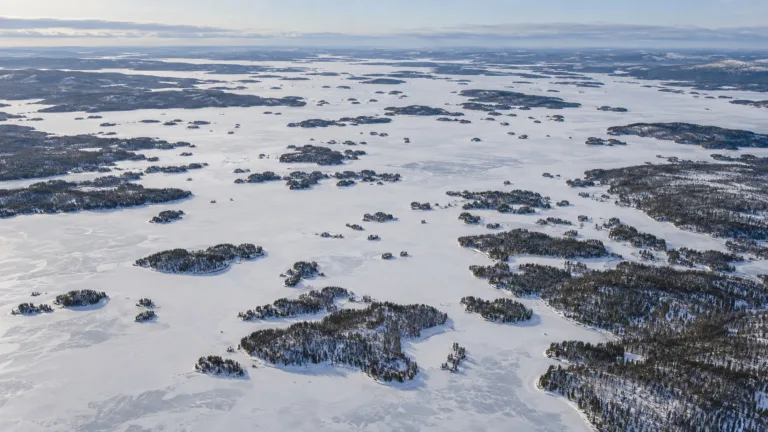
Long seasonal ice cover on a shallow multi-reach lake system
Scientific Lake Database + Official MonitoringInternational Lake Environment Committee — Lake Chany, World Lake DatabaseVNIRO Novosibirsk Branch — Lake Chany Winter Monitoring, March 2021VNIRO Novosibirsk Branch — Lake Chany Expedition, May 2023VNIRO — Lake Chany and Lake Sartlan Expedition, August 2025Peer-Reviewed Study — Spatial Heterogeneity in the Lake Chany SystemEvidence: ModerateCold continental winters combine with a mean depth of only about 2.2 m, limiting deep-water heat storage. Depth, channel flow and mineralization vary among reaches, so local freeze and breakup conditions do not have to develop at the same time.
Where Is Lake Chany?
Novosibirsk Oblast · Russia
Lake Chany on the Globe
Rotate the world or focus directly on the lake.
Measured Ice and Freeze Data
Freeze and Ice Cover Through the Year
Month-level states are shown only when supported. Unclassified months remain explicitly marked.
Evidence Behind the Freeze Profile
The World Lake Database lists Lake Chany's frozen period as October through May.
Scientific Lake DatabaseInternational Lake Environment Committee — Lake Chany, World Lake DatabaseEvidence: HighVNIRO measured 75–85 cm of ice at four monitored locations during late February and early March 2021. This is a dated point measurement rather than a lake-wide normal.
Official MonitoringVNIRO Novosibirsk Branch — Lake Chany Winter Monitoring, March 2021Evidence: HighDuring the 2023 spring survey, VNIRO reported that ice disintegration in the Kozhurla Channel began in the middle of the final third of April. The observation applies to that channel and season, not to simultaneous lake-wide ice-off.
Official Seasonal ObservationVNIRO Novosibirsk Branch — Lake Chany Expedition, May 2023Evidence: HighVNIRO describes Lake Chany as interconnected reaches and shallow passages that differ in depth and mineralization; scientific studies also characterize the system as shallow and saline.
Official Monitoring + Peer ReviewedVNIRO — Lake Chany and Lake Sartlan Expedition, August 2025Peer-Reviewed Study — Spatial Heterogeneity in the Lake Chany SystemEvidence: HighSources
- International Lake Environment Committee — Lake Chany, World Lake Database
- International Association for Great Lakes Research — Lake Chany Profile
- VNIRO Novosibirsk Branch — Lake Chany Winter Monitoring, March 2021
- VNIRO Novosibirsk Branch — Lake Chany Expedition, May 2023
- VNIRO — Lake Chany and Lake Sartlan Expedition, August 2025
- Peer-Reviewed Study — Spatial Heterogeneity in the Lake Chany System
Lake Chany develops seasonal ice for much of the cold half of the year. The lake database record places its frozen period from October through May, but Chany is not a single uniform bowl: it is a broad system of shallow reaches, channels and connected waters where ice formation and spring breakup can progress at different rates.
Why such a large lake can develop an early, long ice season
Lake Chany covers a large area, yet its mean depth is only about 2.2 metres. That distinction matters for winter behavior. A large surface does not automatically imply the deep heat storage found in deep lakes. Much of Chany’s water column is shallow, allowing autumn cooling to affect a large fraction of the stored water before winter becomes established.
The regional continental climate supplies prolonged cold conditions after freeze-up. Chany is also an inland saline lake system rather than a chemically uniform freshwater basin. Mineralization varies spatially, so the freezing point and local thermal behavior are not identical everywhere. Salinity can delay freezing relative to fresher water, while shallow depth favors faster heat loss. The observed winter pattern results from these effects acting together rather than from lake size alone.
Chany’s reaches create different winter environments
Current VNIRO descriptions divide the system into major reaches including Chinyaikhinsky, Tagano-Kazantsevsky and Yarkovsky, together with Malye Chany and connecting shallow passages. These parts differ in depth, mineralization and other physical characteristics. Scientific sampling has likewise documented a transition between river-influenced and more saline lake water within the system.
Those spatial differences matter when interpreting an ice date. A channel influenced by moving water can begin opening while broader lake surfaces remain ice-covered. Shallower areas can cool rapidly, while deeper wintering areas retain more water beneath the ice. A single shoreline or channel observation therefore should not be converted into a whole-lake freeze-up or ice-off date.
The 2021 ice measurement is a snapshot, not a winter normal
VNIRO’s late-February to early-March 2021 survey provides a useful direct measurement of winter conditions. Researchers worked at four locations and made ten hydrological measurements. At those sites, water depth was 220–270 cm and measured ice thickness was 75–85 cm. Snow over the ice was 25–35 cm thick.
The scope of that observation is as important as the number itself. The 75–85 cm range belongs to four monitored locations during one winter period. It does not establish a typical annual maximum, a lake-wide mean thickness or uniform conditions across every reach and channel.
Spring breakup begins locally before the lake is fully ice-free
A VNIRO expedition in 2023 recorded ice disintegration beginning in the Kozhurla Channel during the middle of the final third of April. That observation adds useful detail to the broader October–May frozen-season record: spring opening can begin in channels during April even though May remains part of the lake’s broader breakup period.
This is why Lake Chany is better described with a breakup window than one fixed annual date. Channel flow, water depth, local mineralization, weather and the geometry of the connected reaches can all affect where open water appears first and how quickly the remaining ice disappears.
Why no long-term freeze trend is assigned
The available evidence supports the recurring seasonal ice window, individual winter measurements and dated breakup observations. It does not provide a consistent multi-decade series of standardized, lake-wide ice-on and ice-off dates. A trend toward later freeze-up, earlier breakup or a shorter ice season therefore should not be inferred from these records alone.
Similar Lakes by Freeze Pattern

Lake Onega Freeze
Usually Fully Freezes

Lake Ladoga Freeze
Usually Fully Freezes
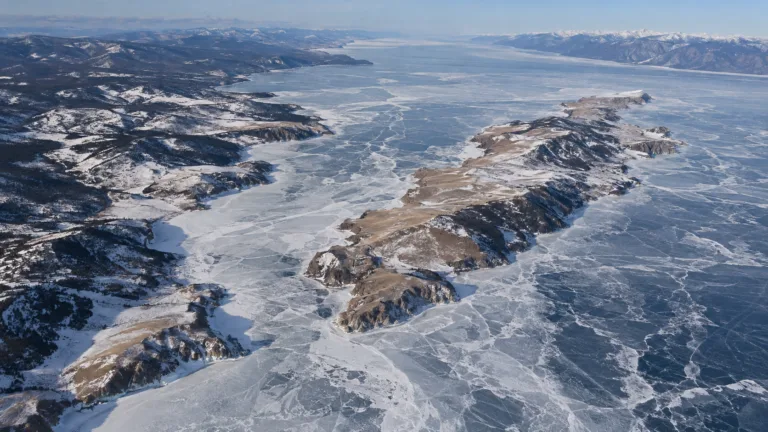
Lake Baikal Freeze
Usually Fully Freezes
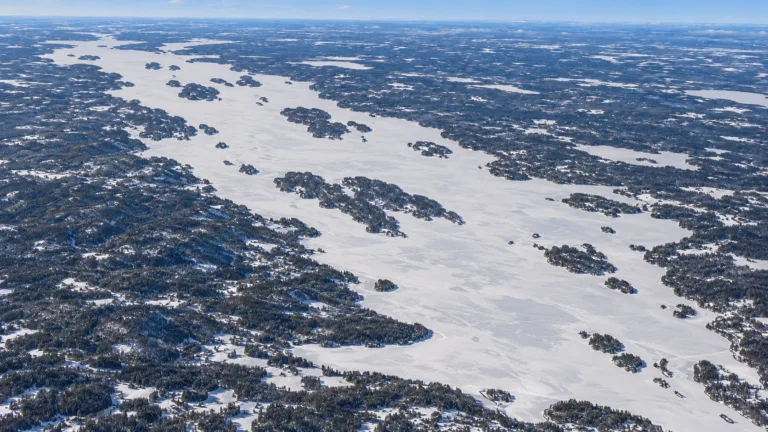
Lake Pielinen Freeze
Usually Fully Freezes
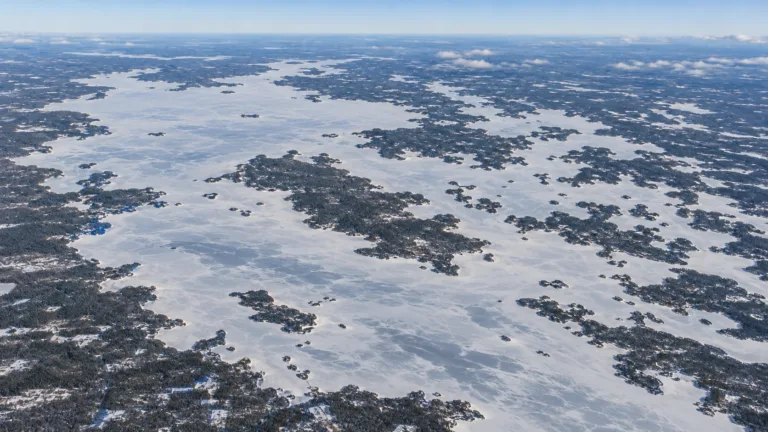
Lake Oulujärvi Freeze
Usually Fully Freezes
Lake Inari Freeze
Usually Fully Freezes