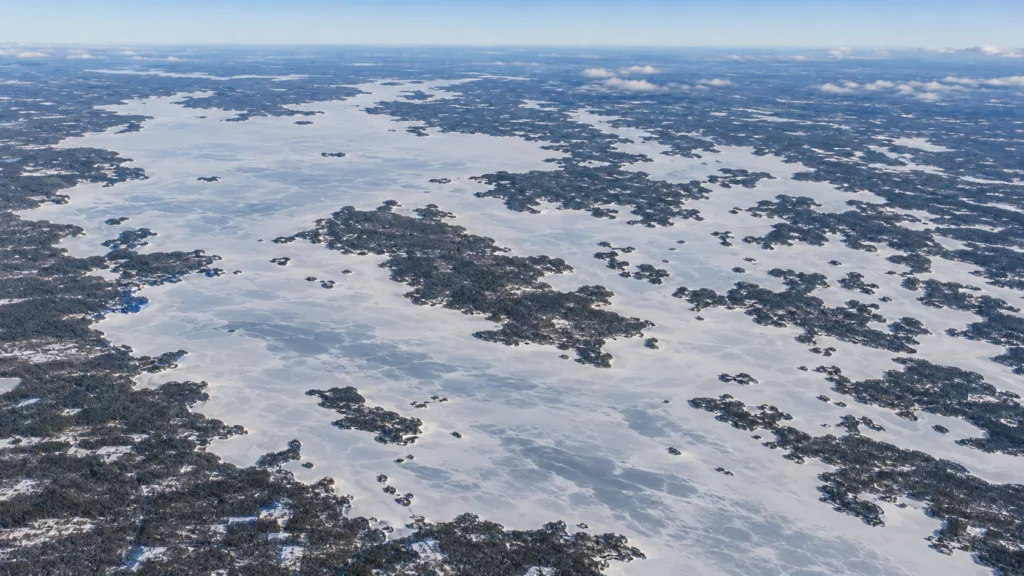
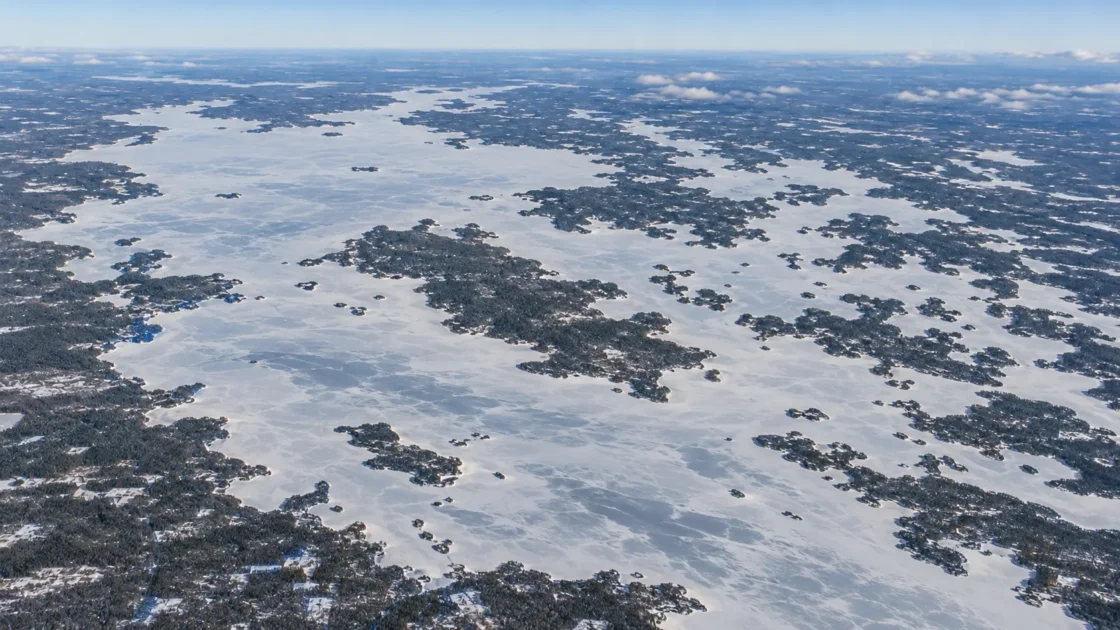
Regular long seasonal ice cover
Peer Reviewed Historical RecordThe Cryosphere — SAR Backscatter during Lake Ice Melt on Lake OulujärviJGR Biogeosciences — Loss of Ice Cover, Shifting Phenology, and More Extreme Events in Northern Hemisphere LakesEvidence: HighCold inland winters sustain months of lake ice, while Oulujärvi's 928 km² surface and large open basins make freeze-up and breakup spatially uneven.
Where Is Lake Oulujärvi?
Kainuu · Finland
Lake Oulujärvi on the Globe
Rotate the world or focus directly on the lake.
Measured Ice and Freeze Data
Freeze and Ice Cover Through the Year
Month-level states are shown only when supported. Unclassified months remain explicitly marked.
Evidence Behind the Freeze Profile
The 1854–2002 record places average freeze-up in the November 10–20 range and average breakup in the May 15–20 range.
Peer Reviewed Historical RecordThe Cryosphere — SAR Backscatter during Lake Ice Melt on Lake OulujärviHydrology Research — Long-term changes in lake ice cover in FinlandEvidence: HighFinnish ice-on records use final freeze-up within sight of the observation site; on a large lake this is not identical to a verified whole-lake freeze-over date.
Scientific DatasetLong-term ice phenology records for Northern Hemisphere lakesEvidence: HighAcross 1853–2018, Oulujärvi ice-on moved later by 0.8 days per decade and ice-off moved earlier by 0.9 days per decade.
Peer ReviewedThe Cryosphere — SAR Backscatter during Lake Ice Melt on Lake OulujärviJGR Biogeosciences — Loss of Ice Cover, Shifting Phenology, and More Extreme Events in Northern Hemisphere LakesEvidence: HighThe Vaala series includes a 139-day ice season in 2000–2001 and a 229-day ice season in 1880–1881.
Peer Reviewed Historical RecordHydrology Research — Long-term changes in lake ice cover in FinlandEvidence: HighFinnish monitoring at Oulujärvi includes Paltaselkä, and the reported thickness applies only to the measurement site rather than the lake as a whole.
Official MonitoringFinnish Environment Institute / Vesi.fi — Kainuu Ice Thickness MonitoringEvidence: HighSources
- The Cryosphere — SAR Backscatter during Lake Ice Melt on Lake Oulujärvi
- Hydrology Research — Long-term changes in lake ice cover in Finland
- Long-term ice phenology records for Northern Hemisphere lakes
- JGR Biogeosciences — Loss of Ice Cover, Shifting Phenology, and More Extreme Events in Northern Hemisphere Lakes
- Finnish Environment Institute / Vesi.fi — Kainuu Ice Thickness Monitoring
Lake Oulujärvi normally develops extensive seasonal ice, but its long-running freeze record should not be interpreted as a single moment when all 928 km² of the lake become ice-covered. The Finnish observation series follows a defined visible area, an important distinction on a lake divided into broad open basins, islands, bays and narrower passages.
What the Vaala freeze record actually measures
Finnish lake-ice observations distinguish several stages of autumn freezing. Shores may freeze first, followed by bays, then the water visible from the observation point. The long Oulujärvi phenology series uses the final freeze-up of the lake within sight of the observer after possible temporary thaws. Ice-off is recorded when ice is no longer visible from that observation site.
That definition works well for tracking change over many decades because the observation method remains comparable through time. It is less suitable as proof that every part of a large lake froze on the same day. On Oulujärvi, a recorded ice-on date therefore describes a monitored seasonal transition rather than an independently verified whole-lake freeze-over event.
The record ranges from October freeze-up to Christmas Eve
The historical series shows how far individual winters can depart from the usual seasonal window. The earliest permanent freeze-up listed for Oulujärvi at Vaala occurred on 22 October 1894. The latest was 24 December 1929. Spring variability was also wide: the earliest recorded breakup through 2002 was 2 May 1921, while the latest was 23 June 1867.
Ice-cover duration reflects both ends of the season. The longest duration in the historical record was 229 days in 1880–1881, compared with only 139 days in 2000–2001. These values are historical extremes rather than descriptions of a normal winter, but their spread shows why one fixed number cannot represent Oulujärvi’s ice season from year to year.
The ice season has shifted from both ends
Oulujärvi’s record is long enough to show change over more than a century. Analysis covering 1853–2018 reports that ice-on moved later by about 0.8 days per decade, while ice-off moved earlier by about 0.9 days per decade. Later formation and earlier disappearance act in the same direction: the seasonal period with ice becomes shorter.
A separate analysis of extreme ice seasons gives another view of that change. For the 1995–2019 period, 42% of Oulujärvi years were classified as having extremely short ice duration relative to the lake’s earlier record. In that study, an extremely short season was defined against the lower tail of the pre-1995 ice-duration distribution, so the 42% figure refers to a specific statistical definition rather than to an arbitrary day-count threshold.
Ice thickness is not the same record as freeze-up
Phenology dates describe when seasonal ice appears and disappears under the observation definition. Ice thickness measures a different property. A recent scientific study of Oulujärvi summarizes historical 1961–2000 ice-cover thickness at roughly 60–70 cm on average, but thickness figures cannot be converted into lake-wide ice extent or used to determine the exact freeze-up date.
The Finnish Environment Institute also maintains point-based ice monitoring on Oulujärvi, including Paltaselkä. Those observations describe conditions at the measurement location on the measurement date. They are not lake-wide averages. Keeping that distinction matters especially on Oulujärvi because a thickness reading, an observer’s visible freeze-up date and the state of distant open-water basins answer three different questions.
Why one date cannot describe every basin
Oulujärvi covers about 928 km², has a mean depth of approximately 7.6 m and reaches about 36 m at its deepest point. Its size alone makes the spatial meaning of an ice observation different from that of a small lake that can be seen almost entirely from one shoreline station.
Sheltered water, exposed open basins and locally deeper areas do not have to pass through freeze-up and breakup at exactly the same time. For that reason, the strongest interpretation of the historical record is as a consistent measure of seasonal ice phenology at the monitored setting. It documents a long winter ice cycle and its change through time without treating a local observation as a precise lake-wide freeze boundary.
Similar Lakes by Freeze Pattern
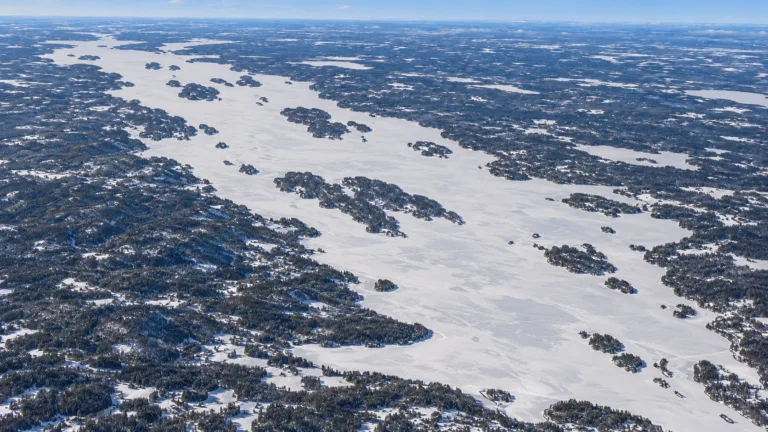
Lake Pielinen Freeze
Usually Fully Freezes
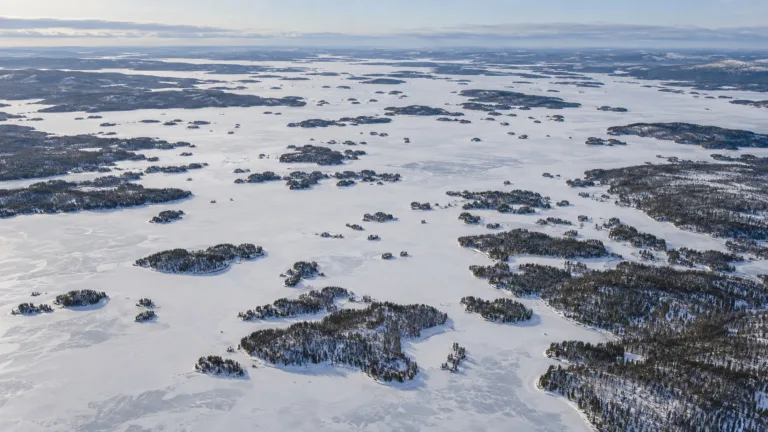
Lake Inari Freeze
Usually Fully Freezes
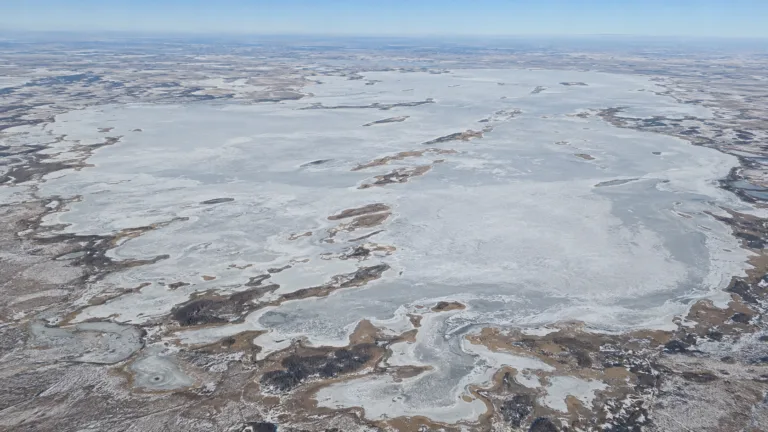
Lake Chany Freeze
Usually Fully Freezes

Lake Onega Freeze
Usually Fully Freezes

Lake Ladoga Freeze
Usually Fully Freezes
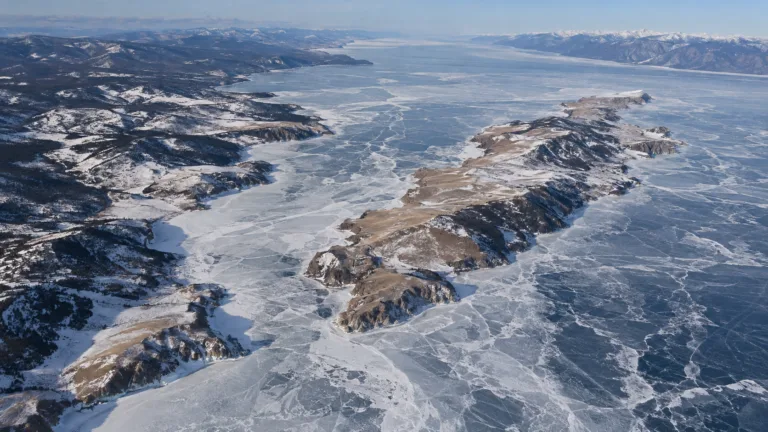
Lake Baikal Freeze
Usually Fully Freezes