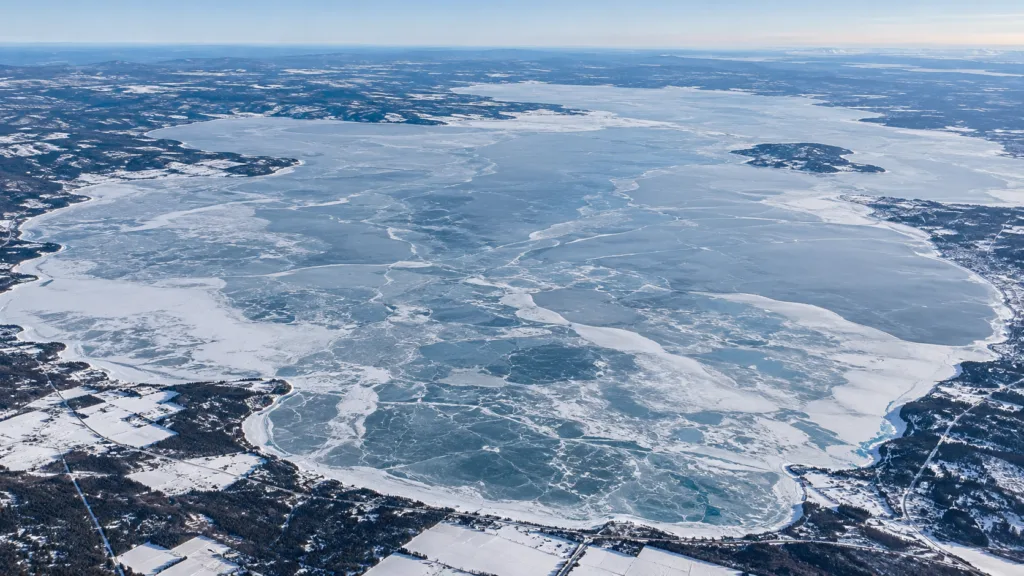
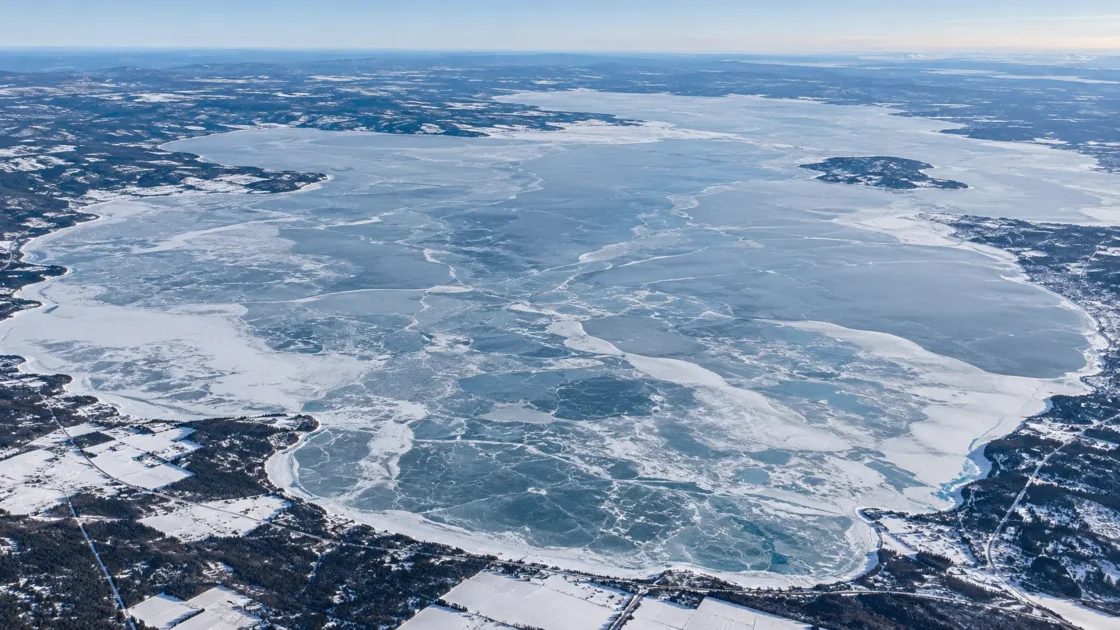
Regular seasonal lake-wide ice cover
Government Lake DataQuébec Environmental Assessment Registry — Lac Saint-Jean 2028–2037 Impact Study, Volume 2BAPE — Programme de stabilisation des berges du lac Saint-Jean, Environmental Impact StudyEvidence: HighShallow bays and nearshore water freeze first. Sustained subfreezing weather then extends ice across the lake, while wind and waves can break early thin ice and delay establishment of a continuous cover over exposed open water.
Where Is Lac Saint-Jean?
Quebec · Canada
Lac Saint-Jean on the Globe
Rotate the world or focus directly on the lake.
Measured Ice and Freeze Data
Freeze and Ice Cover Through the Year
Month-level states are shown only when supported. Unclassified months remain explicitly marked.
Evidence Behind the Freeze Profile
Satellite analysis for winters between 2004 and 2014 showed progressive formation from nearshore and shallow areas toward a completely frozen lake surface; 2007 and 2011 were excluded from that image analysis.
Satellite-Based Lake AnalysisBAPE — Programme de stabilisation des berges du lac Saint-Jean, Environmental Impact StudyEvidence: HighThe 2025 assessment characterized the 1958–2023 historical open-water period at about 213 days, with ice departure near May 10 and freeze-up around December 9.
Government Environmental AssessmentQuébec Environmental Assessment Registry — Lac Saint-Jean 2028–2037 Impact Study, Volume 2Evidence: ModerateTechnical monitoring recorded open water from April 17 to December 19, a 246-day interval compared with a reported 1991–2024 historical range of 201–231 days.
Technical MonitoringQuébec Environmental Assessment Registry — Lac Saint-Jean 2024 Technical Follow-upEvidence: HighThe lake is considered to have reached its traditional ice-departure date when roughly 70% of its surface is open water, a condition assessed by aerial observation.
Historical Monitoring RecordQuébec Environmental Assessment Registry — Lac Saint-Jean 2028–2037 Impact Study, Volume 2Le Lac-St-Jean — 2026 Ice Departure ObservationEvidence: HighThe 2025 assessment projects median ice departure near May 2 and freeze-up near December 17 by 2040, shifting to about April 29 and December 21 by 2070. These are modeled projections rather than observed future dates.
Climate ProjectionQuébec Environmental Assessment Registry — Lac Saint-Jean 2028–2037 Impact Study, Volume 2Evidence: ModerateSources
- Commission de toponymie du Québec — Lac Saint-Jean
- Québec Environmental Assessment Registry — Lac Saint-Jean 2028–2037 Impact Study, Volume 2
- BAPE — Programme de stabilisation des berges du lac Saint-Jean, Environmental Impact Study
- Le Lac-St-Jean — 2026 Ice Departure Observation
- Québec Environmental Assessment Registry — Lac Saint-Jean 2024 Technical Follow-up
Lac Saint-Jean normally develops a lake-wide winter ice cover, but the transition from open water to a continuous frozen surface is gradual. Nearshore ice can appear well before exposed parts of the lake lock up, and the spring “ice departure” record uses a defined open-water threshold rather than requiring every remaining piece of ice to disappear.
Why freeze-up does not happen everywhere at once
Lac Saint-Jean covers roughly 1,041 km² and has an average depth of about 11 m, although its deepest areas are much greater. Its broad surface means that early winter conditions can differ substantially between protected shallow water and wind-exposed open water.
Satellite-based analysis found that ice typically begins along the shore and in small, shallow bays. Early ice in these areas can be thin enough to disappear during mild spells. At the same time, wind across unfrozen portions of the lake can maintain waves or break a thin cover that formed during calmer weather. Continuous lake-wide ice therefore represents a later stage of freeze-up, not the first appearance of ice around the shoreline.
December is the key transition from open water to winter cover
Long-term assessments place freeze-up around the first part of December. A recent analysis of the 1958–2023 period produced a characteristic freeze-up date near December 9, while an earlier reference-period assessment placed it near December 10. Observations used in the newer study likewise center the freeze transition in December rather than on a fixed annual date.
This distinction matters because short periods of early shoreline ice do not necessarily mark the end of the open-water season. The lake can still contain large exposed areas after ice has begun forming locally.
What the traditional spring “ice departure” date actually measures
Lac Saint-Jean has an unusually recognizable local spring ice record. Since the late twentieth century, aerial observations have been used to judge the state of the lake. The traditional departure date is reached when approximately 70% of the lake surface is open water.
That definition means the recorded date is not the instant when the final ice disappears. It is a repeatable threshold intended to describe the major transition from the winter cover to predominantly open water. In 2026 that threshold was reached on May 11. The long-term timing is generally centered in early May, but individual springs can depart substantially from that central tendency.
The 2024 season illustrates the size of year-to-year variability
The 2024 technical record stands out because the lake reached its spring ice-departure condition on April 17 and did not reach freeze-up until December 19. That produced a 246-day open-water period. The same technical assessment compared this with a 1991–2024 historical range of roughly 201 to 231 days.
A season such as 2024 should not be treated as the normal calendar for Lac Saint-Jean. It demonstrates instead how both spring breakup and autumn freeze-up can shift enough to change the annual ice season by several weeks.
Projected change is toward a longer open-water season
The latest environmental assessment separates historical observations from modeled future conditions. Its historical 1958–2023 series gives an open-water period of about 213 days, with ice departure near May 10 and freeze-up near December 9.
Under the climate scenarios used in that assessment, the median seasonal boundaries move farther apart. The modeling places ice departure near May 2 and freeze-up near December 17 around the 2040 horizon, followed by approximately April 29 and December 21 around 2070. These dates are scenario-based projections rather than predictions for any individual year, but they describe a consistent physical direction: less of the calendar occupied by the seasonal ice cover and more by open water.
Similar Lakes by Freeze Pattern
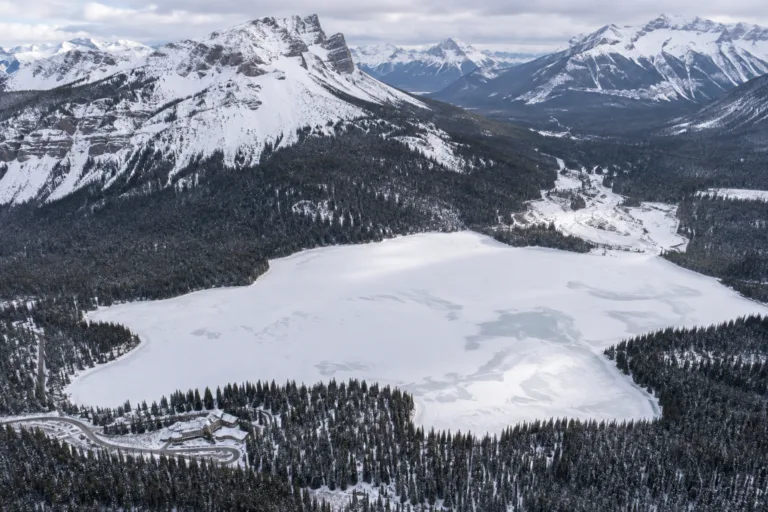
Emerald Lake Freeze
Usually Fully Freezes
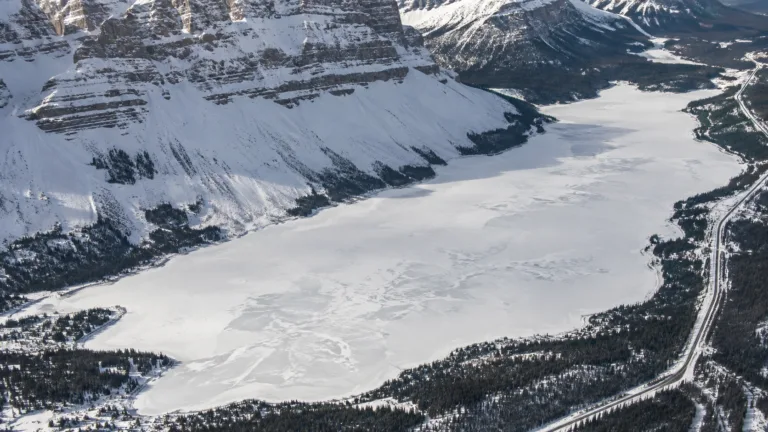
Bow Lake Freeze
Usually Fully Freezes
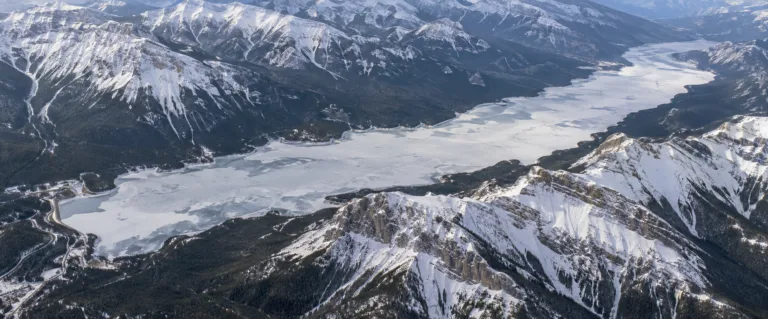
Lake Minnewanka Freeze
Usually Fully Freezes
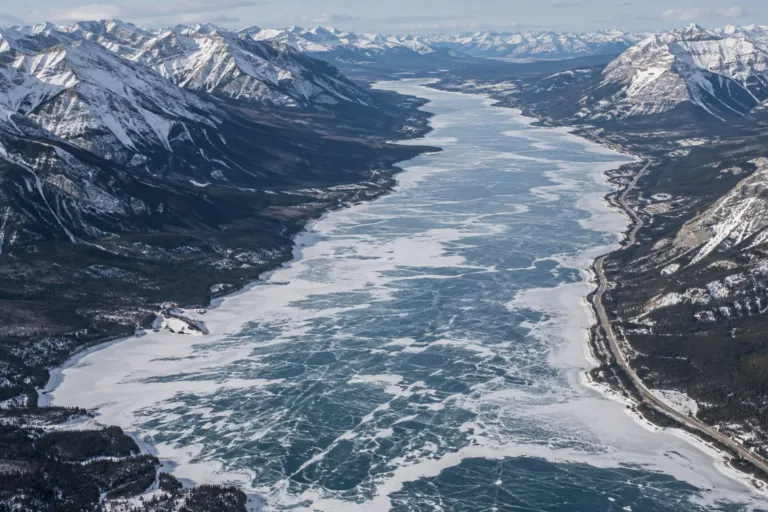
Abraham Lake Freeze
Usually Fully Freezes
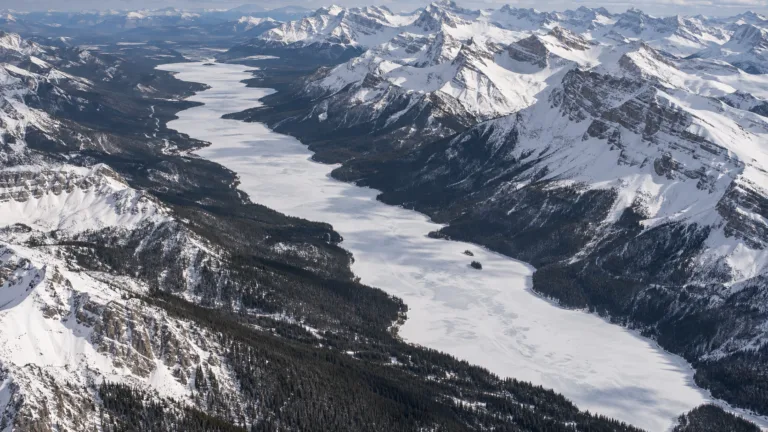
Maligne Lake Freeze
Usually Fully Freezes
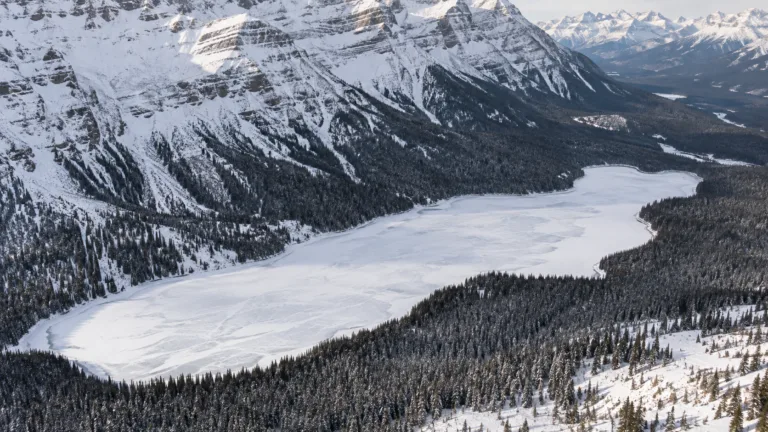
Peyto Lake Freeze
Usually Fully Freezes